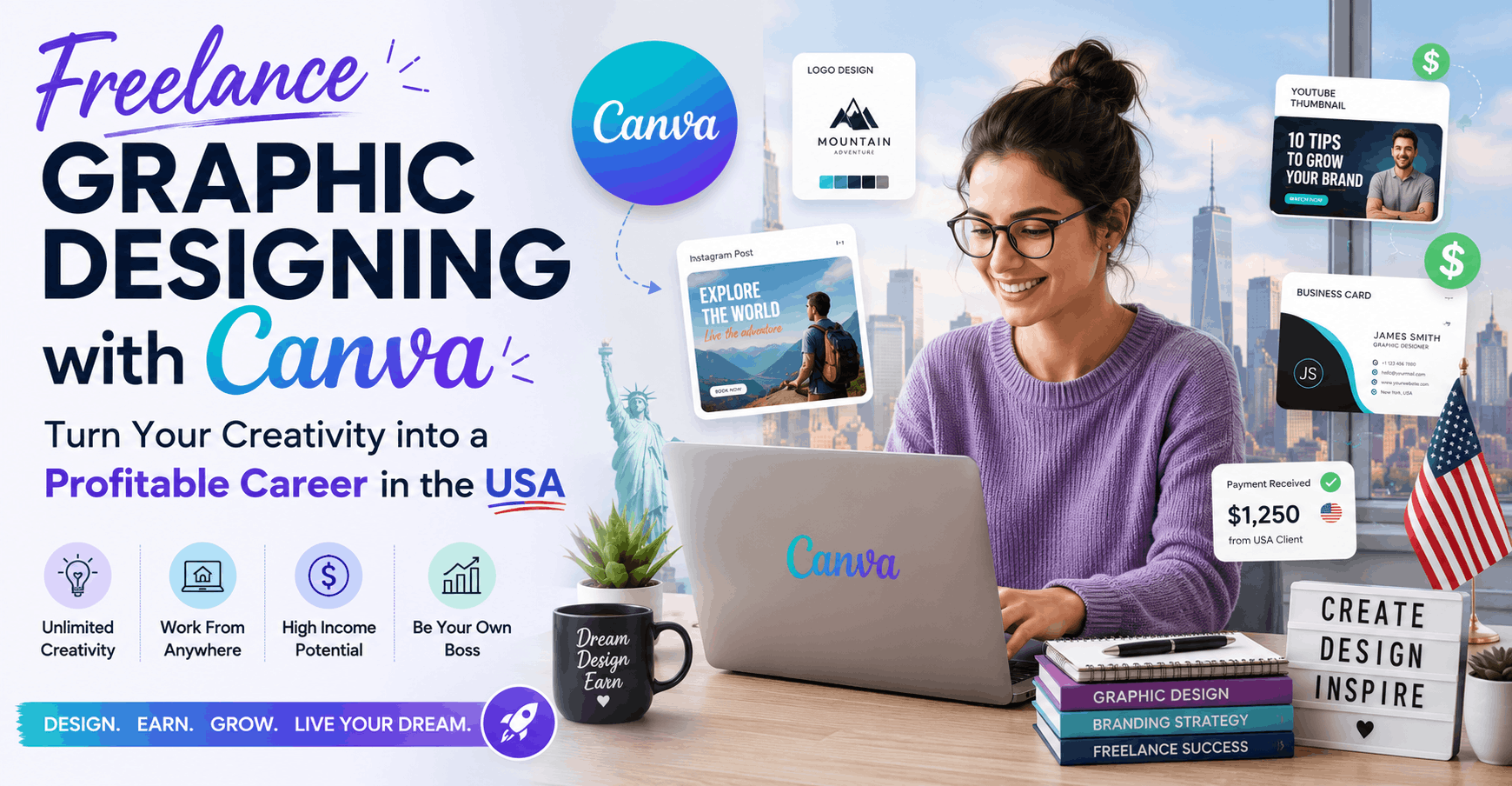
Freelance Graphic Designing with Canva: Turn Your Creativity into a Profitable Career in the USA
Published: June 2026 | Reading Time: 12 Minutes | Category: Online Business | For: All Ages — USA
In Austin, Texas, a 24-year-old former retail worker now earns $4,200 a month designing Instagram graphics for small businesses — entirely from her laptop, entirely using Canva, entirely without a design degree. In Charlotte, North Carolina, a 52-year-old former office manager replaced her full-time income within fourteen months doing the exact same thing. Neither of them had ever touched Adobe Photoshop. Neither had taken a single college course in design.
This is not an exception story. It is the new reality of the American creative economy. The graphic design industry in the United States alone is worth $13.3 billion, and 90% of the entire graphic design industry is made up of freelancers — not agencies, not corporate teams, but independent people working from home in cities like Phoenix, Denver, Nashville, Tampa, and Columbus, building real businesses one client at a time.
What changed everything is a single platform: Canva. With more than 260 million monthly active users worldwide and the United States representing its single largest traffic source at over 14%, Canva has done something Photoshop never could — it removed the technical barrier between “having a creative eye” and “actually producing professional design work.” You no longer need years of software training. You need taste, consistency, and a plan to find clients. This guide gives you all three.
 What This Guide Covers
- Section 1 — Why Canva Freelancing Is Booming in the USA Right Now
- Section 2 — What You Can Actually Sell as a Canva Freelancer
- Section 3 — Getting Started: Your First 30 Days
- Section 4 — Canva Skills That Actually Get You Hired
- Section 5 — Where to Find Your First US Clients
- Section 6 — How Much You Can Realistically Charge and Earn
- Section 7 — Building a Portfolio With Zero Clients
- Section 8 — Tools That Pair Perfectly With Canva
- Section 9 — Real Stories from Real American Freelancers
- Section 10 — Common Mistakes That Kill New Freelancers
- Section 11 — Your 90-Day Action Checklist
- FAQ — Your Most Common Questions Answered
Section 1 — Why Canva Freelancing Is Booming in the USA Right Now
Three forces are converging at the same time, and together they are creating one of the most accessible income opportunities available to Americans in 2026.
First, every business now needs constant visual content. A coffee shop in Seattle needs Instagram posts. A real estate agent in Miami needs listing flyers. A consultant in Chicago needs a pitch deck. A boutique in Savannah, Georgia needs email graphics for their newsletter. 81% of businesses now rely on graphic design regularly — and most of them, especially small businesses, cannot afford a full-time in-house designer or a traditional agency.
Second, Canva has made professional output achievable for non-designers. The platform now has over 4.5 million ready-made templates and is used by 95% of Fortune 500 companies alongside millions of small businesses. This means the tool you are learning is not a hobbyist app — it is genuinely the platform that real American businesses, from Starbucks to your neighborhood bakery, actually use.
Third, remote, flexible income is in higher demand than ever. Remote design jobs increased 150% between 2020 and 2025, and freelance graphic designers in the US now average $45 to $75 per hour, with specialists charging $100 to $150+.
| The Graphic Design Economy — USA 2026 | Figure |
|---|---|
| US graphic design market size | $13.3 Billion |
| Percentage of industry made up of freelancers | 90% |
| Graphic designers employed in the US (BLS) | 507,690 |
| US median graphic designer salary | $58,910–$61,300/year |
| Top 10% earners (US) | $97,270–$103,030/year |
| Freelance hourly rate range (US) | $45–$150/hour |
| Canva global monthly active users | 260 Million+ |
| USA share of Canva’s global traffic | 14.38% (largest single market) |
| Remote design job growth (2020–2025) | 150% |
| Annual US job openings from turnover (BLS) | 22,800 |
This is a genuine, large, growing market — not a fad. And unlike most online income paths, the barrier to entry is lower today than it has ever been.

Section 2 — What You Can Actually Sell as a Canva Freelancer
“Graphic design” sounds broad and intimidating. In practice, successful Canva freelancers in the USA specialize in a handful of specific, repeatable, high-demand deliverables. Here is exactly what businesses are paying for right now.
| Service | Who Buys It | Typical Price (USA) |
|---|---|---|
| Social media post templates (monthly packages) | Small businesses, coaches, influencers | $200–$800/month |
| Logo and brand kit design | Startups, small businesses | $150–$1,200 |
| Pitch decks / investor presentations | Startups, consultants, sales teams | $300–$2,500 |
| Email marketing graphics | E-commerce brands, newsletters | $100–$500/project |
| Etsy/print-on-demand product mockups | Etsy sellers, POD entrepreneurs | $50–$300/set |
| Resume and LinkedIn banner design | Job seekers, professionals | $25–$150 |
| Real estate flyers and listing graphics | Real estate agents, property managers | $50–$250/listing |
| YouTube thumbnails and channel branding | Content creators, YouTubers | $15–$75/thumbnail |
| Restaurant menus and signage | Restaurants, cafes, food trucks | $100–$600 |
| Canva template kits (sold passively) | Other small business owners, on Etsy | $5–$30/kit, sold repeatedly |
Notice the last row: you can also sell Canva templates as a passive digital product on Etsy, completely separate from client work — meaning a single Canva skillset can generate both active freelance income and passive product income simultaneously.
Section 3 — Getting Started: Your First 30 Days
Here is a realistic, week-by-week plan based on how successful American Canva freelancers actually got started — not a vague “just start designing” suggestion.
Week 1 — Learn the Platform Properly
- Sign up for Canva Pro (currently around $120/year, or use the free version to start — Pro unlocks premium templates, brand kits, and background remover)
- Spend 2-3 hours daily working through Canva’s own free tutorials and YouTube channels dedicated to Canva training
- Recreate 5 designs you admire from real brands — not to publish, just to build muscle memory with the tools
- Learn the fundamentals: brand colors, font pairing, spacing/alignment, and the “Brand Kit” feature
Week 2 — Pick Your Niche
The single biggest mistake new freelancers make is trying to be a generalist. Specializing in one category — for example, “Instagram content for fitness coaches” or “Etsy product mockups” — makes you easier to find, easier to refer, and easier to charge premium rates for, because you become the obvious specialist rather than one of thousands of generic designers.
Week 3 — Build 10 Mock Projects
Before you have a single client, create 10 high-quality mock designs in your chosen niche — pretend client projects that showcase exactly what you can do. These become the foundation of your portfolio.
Week 4 — Set Up Your Profiles and Start Outreach
- Create profiles on Fiverr and Upwork with your mock portfolio
- Set up an Instagram business account showcasing your work
- Send 5 cold outreach messages per day to small businesses in your area or niche
- Offer your first 1-2 projects at a discount in exchange for a testimonial and permission to showcase the work
Section 4 — Canva Skills That Actually Get You Hired
Clients are not paying for “knowing Canva.” They are paying for specific, visible skills that solve their problem. Here are the skills that separate hireable freelancers from hobbyists.
| Skill | Why It Matters to Clients |
|---|---|
| Brand Kit consistency | Clients need every design to match their exact colors, fonts, and logo placement automatically |
| Typography and font pairing | Bad font combinations are the #1 sign of amateur design — clients notice immediately |
| Background Remover and photo editing | Clean product photos and cutouts are constantly requested for e-commerce and social media |
| Magic Resize / multi-format delivery | Clients need the same design resized for Instagram, Facebook, email, and print simultaneously |
| Animation and video basics | Animated social posts and short video ads command significantly higher rates |
| Canva AI tools (Magic Design, Magic Write) | Speeds up delivery dramatically, letting you take on more clients without more hours |
| Print-ready file export (bleed, CMYK awareness) | Essential for flyers, menus, and physical print materials — a common beginner mistake |
You do not need to master all seven before starting. Most successful freelancers in the USA begin with Brand Kit consistency and typography, then add skills as client demand reveals what is needed.
Section 5 — Where to Find Your First US Clients
Freelance Marketplaces
- Fiverr.com — Best for beginners; create specific “gigs” (e.g., “I will design 5 Instagram posts for your small business”) starting at $25-$75
- Upwork.com — Better for ongoing client relationships and larger projects; US businesses post jobs daily across every niche
- 99designs.com — Contest-based platform good for building a portfolio quickly, though pay per win can be lower initially
Direct Local Outreach
This is often the fastest path to your first paying client. Walk into or email local businesses in your city — restaurants in Nashville, boutiques in Charleston, gyms in Denver, real estate offices in Tampa — and offer a free or heavily discounted first project in exchange for a testimonial. Local businesses are often the most underserved when it comes to professional design and the most willing to take a chance on a new freelancer.
Social Media and Content Marketing
Post your design work consistently on Instagram and TikTok, tagging it clearly as available freelance work. Many American freelancers report that 30-40% of their clients eventually come through organic social media discovery once they have built a visible portfolio.
Facebook Groups and Local Business Networks
Join Facebook groups specific to your city (e.g., “Austin Small Business Owners,” “Charlotte Entrepreneurs”) and niche-specific groups (e.g., “Etsy Sellers USA,” “Real Estate Agents Marketing Tips”). These groups are filled with potential clients actively asking for design recommendations.

Section 6 — How Much You Can Realistically Charge and Earn
Pricing confidently is one of the hardest parts of starting out. Here is an honest, realistic income progression based on actual freelancer trajectories in the US market.
| Stage | Time to Reach | Hourly/Project Rate | Monthly Income Range |
|---|---|---|---|
| Complete Beginner | 0–1 month | $15–$25/hr or $25–$75/project | $200–$600 |
| Building Reputation | 1–4 months | $25–$40/hr | $800–$2,000 |
| Established Freelancer | 4–12 months | $40–$65/hr | $2,500–$5,500 |
| Niche Specialist | 1–2 years | $65–$120/hr | $5,500–$10,000+ |
| Agency Owner (hiring others) | 2+ years | N/A — team-based | $10,000–$40,000+ |
The single biggest income lever is not skill level — it is moving from one-time projects to monthly retainer clients. A small business paying $400/month for ongoing social media graphics is worth far more over a year than ten one-off $40 gigs, and it requires far less constant client-hunting.
Section 7 — Building a Portfolio With Zero Clients
Every freelancer faces the same paradox at the start: clients want to see proof of work, but you cannot get proof of work without clients. Here is how successful American Canva freelancers solve this.
- Create fictional “rebrand” projects — pick a real local business (a coffee shop, a gym) and design an improved social media kit for them, clearly labeled as a concept project, then share it publicly tagging the business
- Offer 2-3 free or discounted starter projects — in exchange for an honest testimonial and permission to showcase the final work
- Enter Canva design challenges and templates marketplace — published templates double as portfolio pieces and can earn passive royalties
- Document your process publicly — posting before/after transformations and quick design tips on Instagram or TikTok builds an audience that doubles as social proof
Ten strong mock or discounted projects, presented professionally, are enough to start landing real, paying clients. Quality and consistency matter more than quantity at this stage.
Section 8 — Tools That Pair Perfectly With Canva
| Tool | What It Adds | Cost |
|---|---|---|
| Canva Pro | Premium templates, Brand Kit, background remover, Magic tools | ~$120/year |
| Unsplash / Pexels | Free high-quality stock photography | Free |
| Coolors.co | Generate professional color palettes quickly | Free |
| Notion or Trello | Organize client projects and deadlines | Free |
| Stripe or PayPal | Invoice and collect payments from US clients | Free to set up (transaction fees apply) |
| Calendly | Let clients book consultation calls automatically | Free tier available |
Section 9 — Real Stories from Real American Freelancers
Brianna, 24 — Former Retail Worker, Austin, Texas
Brianna worked at a clothing retailer for three years before deciding to learn Canva on her lunch breaks. She specialized specifically in Instagram content for boutique fitness studios after noticing how many of them had outdated, inconsistent social media. She designed three free “rebrand concepts” for local Austin gyms and posted them publicly, tagging each business. One gym owner reached out within a week. Eighteen months later, she manages monthly content packages for nine fitness studios across Texas, earning $4,200 per month working roughly 25 hours per week. Her advice: “I didn’t wait until I felt ready. I designed for businesses that didn’t even know they needed me yet.”
David, 52 — Former Office Manager, Charlotte, North Carolina
After being laid off from a manufacturing company, David — with zero design background — started learning Canva through free YouTube tutorials, dedicating four hours daily for two months. He focused on real estate marketing materials, a niche he understood from years of office administration work. He cold-emailed 40 real estate agents in the Charlotte area offering free listing flyers for the first project. Six agents responded. Fourteen months later, he works with 22 real estate agents across North Carolina on a retainer basis, earning $5,800 per month — more than his previous full-time salary. His reflection: “I assumed creative work was for young people with art degrees. I was wrong on both counts.”
Sofia, 31 — Stay-at-Home Mom, Tampa, Florida
Sofia began designing Canva templates for Etsy during her children’s nap times, starting with simple resume templates. She had no client work initially — just digital products. Her first month earned $40. By focusing specifically on wedding planning templates after noticing a gap in the market, her Etsy shop grew steadily. She now has 85 templates listed and earns approximately $2,100 per month in largely passive income, working an estimated 8-10 hours per week on new designs and customer messages. Her takeaway: “I never had to find clients. I just had to find a problem people were already searching for solutions to.”
Section 10 — Common Mistakes That Kill New Freelancers
Mistake 1 — Trying to serve everyone. Generalist freelancers compete against thousands of other generalists on price alone. Specialists in a specific niche — Etsy mockups, fitness studio content, real estate flyers — become the obvious, memorable choice and can charge significantly more.
Mistake 2 — Underpricing from fear. Charging $5 for work that takes three hours trains clients to undervalue your time and makes sustainable income mathematically impossible. It is better to charge a fair rate and work with fewer clients than to work constantly for rates that do not add up to a livable income.
Mistake 3 — Inconsistent branding on your own profiles. A freelancer whose own Instagram, portfolio, and proposals look mismatched and unpolished sends a contradictory message about their design skills. Your own presence is your best advertisement.
Mistake 4 — No contracts or unclear scope. Verbal agreements about “a few social media posts” lead to scope creep and unpaid extra work. Even simple freelancers should use a basic written agreement outlining exactly what is included, the number of revisions, and payment terms — free templates are widely available through platforms like HelloBonsai or And.co.
Mistake 5 — Giving up before month three. Nearly every successful freelancer interviewed for this guide describes a slow first 60-90 days followed by accelerating momentum once testimonials and referrals begin compounding. Quitting at week four, before the compounding effect kicks in, is the most common reason new freelancers fail to ever reach sustainable income.
Section 11 — Your 90-Day Action Checklist
| Action | Done? | Timeframe |
|---|---|---|
| Sign up for Canva (free or Pro) and complete tutorials | ☐ | Week 1 |
| Choose your specific niche | ☐ | Week 1–2 |
| Create 10 mock portfolio projects | ☐ | Week 2–3 |
| Set up Fiverr and Upwork profiles | ☐ | Week 3–4 |
| Send 5 outreach messages daily to local businesses | ☐ | Week 4 onward |
| Land first 2-3 discounted/free projects for testimonials | ☐ | Month 1–2 |
| Set up payment system (PayPal/Stripe) and basic contract | ☐ | Month 1 |
| Post design work consistently on Instagram/TikTok | ☐ | Ongoing |
| Raise rates after first 5 paying clients | ☐ | Month 2–3 |
| Pursue first retainer/monthly client relationship | ☐ | Month 3 |
❓ Frequently Asked Questions
Q: Do I need a design degree to become a freelance Canva designer?
No. The majority of successful Canva freelancers in the USA have no formal design education. What matters far more is developing a genuine eye for clean, consistent visual work, understanding basic principles like typography and spacing, and being reliable and easy to work with. Clients hiring at the freelance level are evaluating your portfolio and communication, not your academic credentials.
Q: Is Canva Pro worth paying for, or can I start with the free version?
You can absolutely start with the free version, which includes a substantial template library and core design tools. However, Canva Pro (roughly $120/year) unlocks features that clients specifically expect from professionals — Brand Kit for consistent client branding, the background remover tool, premium templates, and resizing tools that save significant time. Most freelancers upgrade to Pro within their first month once they land paying clients, since the cost is easily recovered with a single project.
Q: How much should I charge as a complete beginner?
Starting rates of $15-$25 per hour or $25-$75 per simple project (such as a set of 5 social media posts) are realistic and competitive for beginners on platforms like Fiverr. Resist the urge to charge far below this range — it is difficult to raise prices later with existing clients, and extremely low rates often attract more demanding clients rather than fewer. Focus on collecting strong testimonials in your first few projects, then raise rates with each new client.
Q: Can I really make a full-time income doing this, or is it just side money?
Both are genuinely possible. Many freelancers use Canva design as supplemental income of $500-$1,500 per month, while others — like the case studies in this guide — have replaced full-time salaries entirely, earning $4,000-$10,000+ monthly. The difference typically comes down to time invested, niche specialization, and the shift from one-off projects to recurring monthly retainer clients, which provides predictable, compounding income.
Q: What is the fastest way to land my very first paying client?
Direct local outreach combined with a free or heavily discounted first project tends to produce the fastest results. Identify 10-15 small businesses in your city or niche that have visibly outdated or inconsistent visual branding, create a quick concept design for one of them as a demonstration, and reach out directly via email or Instagram DM. This approach typically produces a first client within one to three weeks, faster than waiting for marketplace algorithms on platforms like Fiverr or Upwork to surface your profile organically.
Q: Should I specialize in one type of design or stay general?
Specializing significantly accelerates both client acquisition and pricing power. A freelancer who is “the Etsy mockup specialist” or “the real estate flyer designer” becomes memorable, referable, and able to charge premium rates because clients perceive deep expertise rather than generic competence. Most successful freelancers in this guide chose a specific niche within their first month and stuck with it for at least a year before expanding into adjacent services.
Q: How do I handle taxes as a freelance graphic designer in the USA?
Freelance income is taxable self-employment income under US federal law. If you earn more than $400 in a year from freelance work, you are required to report it to the IRS via Schedule C on Form 1040, and you will likely need to pay quarterly estimated taxes once your income becomes consistent. Platforms like Upwork and Fiverr will issue a 1099 form if you earn over $600 from them in a calendar year. Setting aside 25-30% of your freelance income in a separate savings account for taxes is a widely recommended practice among US freelancers.
Q: What if I don’t have any design “talent” — can I really learn this?
What most people call design talent is largely a learnable skill set: understanding spacing, color theory, font pairing, and visual hierarchy. Canva’s templates, combined with consistent practice recreating designs you admire, build this skill faster than most people expect. Every freelancer profiled in this guide started with zero formal training. The defining factor in their success was consistent practice and a willingness to start before feeling fully ready — not innate artistic talent.
Final Thought
The barrier between “I have a creative eye” and “I run a real design business” has never been thinner than it is right now. Whether you are a recent graduate in Boston, a parent looking for flexible income in Tampa, a career-changer in Charlotte, or a retiree exploring something new in Scottsdale — Canva has removed the technical excuse that used to stop people from starting.
The market is real: $13.3 billion in the US alone, growing, and largely powered by freelancers exactly like the people who will read this guide. You do not need permission, a degree, or expensive software. You need a niche, ten honest portfolio pieces, and the willingness to send the first outreach message.
Found this guide useful? Share it with someone you know who has creative instincts but has never thought of them as a career. Sometimes that is all the push someone needs.