
Facebook Marketplace Phone Number Scam Share Yours USA
📅 Published: October 2026 | ⏱ Reading Time: ~20 Minutes | 🗂 Category: DIGITAL WORLD | 👥 For: Facebook Marketplace sellers and buyers in the USA
Imagine you’re selling a used standing desk in Columbus, Ohio. You list it for $180 on a Saturday morning, and eleven minutes later a buyer writes, “Is this still available?” Then: “Can I text you? Messenger keeps glitching.” You send your number. A text from Google arrives with a six-digit code, and the buyer says to forward it so they know you’re real. You do. The buyer disappears, the desk is still in your garage, and your phone number now works for someone else’s scam.
The scale is hard to ignore. The FTC says Americans reported $15.9 billion in fraud losses in 2025, up from just over $12 billion in 2024, across 3 million reports (from its March 2026 testimony to Congress). The FBI’s Internet Crime Complaint Center logged 1,008,597 complaints and $20.877 billion in losses for 2025, a 26% jump, according to CyberScoop’s coverage of the FBI’s 2025 Internet Crime Report. Those two datasets count different things, so don’t add them together. Social media is a big slice: the FTC Data Spotlight on social media scams shows scams that started on social platforms cost people more than $2 billion in 2025.
This kind of fraud looks harmless because nobody takes your cash. That’s why it works. A fake buyer asking for your phone number in Tampa, Florida or Denver, Colorado gets what they need, and the damage shows up later as spam calls, a locked Google account or a bank alert. The FTC first warned about the Facebook Marketplace Google Voice scam in October 2021, and local news stations from Terre Haute, Indiana to Miami, Florida have been repeating the warning since.
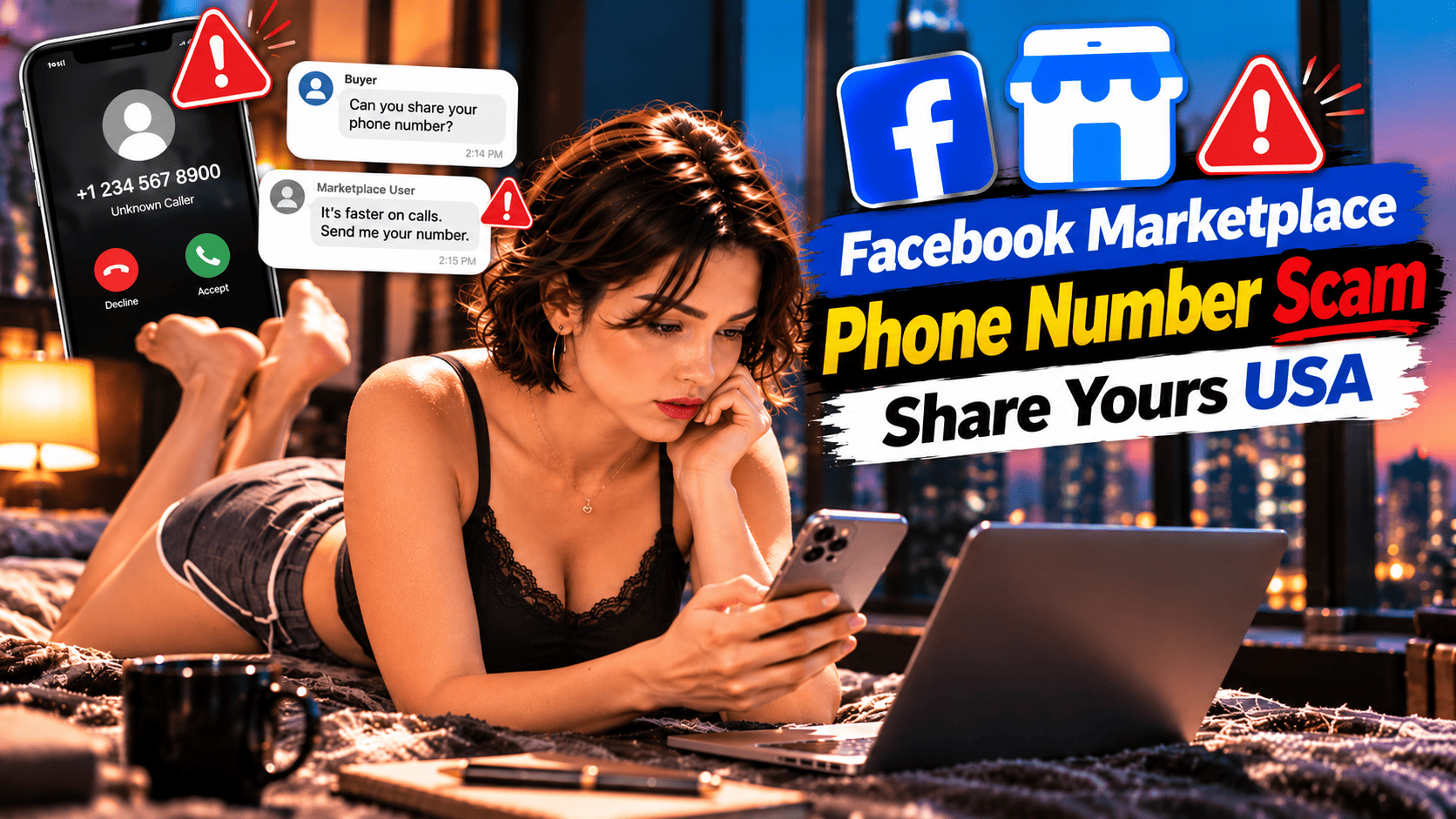
This guide walks through the Facebook Marketplace phone number scam from the first message to the cleanup. You’ll get real US dollar figures, the agencies that handle each problem, a recovery plan you can finish in an afternoon, clearly labeled made-up examples, and a spot to share yours.
Let’s get into it.
📋 Table of Contents
- Why Marketplace Sellers in the USA Are the Target
- How the Scam Works, Step by Step
- Pattern 1: The Google Voice Code Swap
- Pattern 2: The “Is This Still Available?” Number Grab
- Pattern 3: The Multi-Account Code Request
- Pattern 4: The Fake Payment Screenshot
- Pattern 5: Off-Platform Links and Fake Payment Notices
- Pattern 6: Spoofed Calls and a Locked Google Account
- Pattern 7: The Identity Theft Follow-Up
- Pattern 8: SIM Swap and Port-Out Escalation
- What It Costs You and What Protection Costs
- US Rules and Agencies: Who Handles What
- Realistic Risk and Cost Comparison
- Where to Report It
- What to Do If You Already Sent the Code
- Made-Up Examples: Sellers Across the USA
- Red Flags and Mistakes to Avoid
- Free and Paid Tools
- Quick Reference Checklist
- Share Yours
- Frequently Asked Questions (FAQ)
- Final Thought
Why Marketplace Sellers in the USA Are the Target
Marketplace has a trust gap that sellers don’t notice at first. Anyone with a Facebook account can message you, and a big platform doesn’t mean anyone has vetted the buyer. AARP’s Fraud Watch Network has made that point. Meta’s Marketplace trust and safety page says requests to move to phone or email early in a chat can signal ill intent, especially in vehicle, rental and home goods listings.
A working US phone number is valuable. the BBB’s scam alert for sellers explains that scammers use the trick to look like they have a US-based number, which makes their next calls feel local. If those calls get reported, the trail leads to you. An FTC official told WJLA in Washington, D.C. that scam activity tied to your number could even get your Google profile suspended.
Speed helps the scammer too. You listed a $180 desk or a $650 couch, you want it gone, and you reply fast. One seller in Kent, Ohio told News 5 Cleveland in October 2022 that roughly nine of every ten inquiries looked like scams. That’s one person’s report, not a statistic, but it matches the warning signs the BBB and Meta describe.
What you gain by spotting this early:
- ✅ Your number stays yours. No hidden Google Voice account sits on top of it.
- ✅ Your Google profile stays safe. You avoid the suspension risk the FTC expert described.
- ✅ No phantom calls. Strangers in Phoenix or Seattle won’t be calling you back about robocalls you never made.
- ✅ Fewer follow-up scams. Fake bank texts and payment links get harder for them to time.
- ✅ A clean credit file. The strongest protections cost $0.
- ✅ A faster recovery. Reclaiming a number takes minutes when you act the same day.
- ✅ Safer meetups. You’re already thinking like a careful seller.
| Signal | Real buyer | Phone number scammer |
|---|---|---|
| First message | Asks about size, color or condition ✅ | “Still available?” and nothing else ❌ |
| Wants your number early? | Rarely; Messenger works ✅ | Almost immediately ❌ |
| Asks for a code sent to you? | Never ✅ | Yes, “to verify you’re real” ❌ |
| Wants to leave Messenger? | Not unless you suggest it ✅ | Pushes to text, call or email ❌ |
| Payment | Cash in person or a payment you confirm yourself ✅ | Screenshots, deposits, odd links ❌ |
| Verdict | ⭐⭐⭐⭐⭐ Proceed with normal care | ⭐ Block and report |
Facebook Marketplace Phone Number Scam: How It Works, Step by Step
The script barely changes from Boston, Massachusetts to Miami, Florida. One scammer’s text, reported by Boston 25 News, said “If your post is real, send me the code, then I’ll call.” That single line contains the whole trick.
| Stage | What the scammer says | What is really happening |
|---|---|---|
| 1. Opening | “Is this still available?” | They test how fast you reply and whether you ask questions. |
| 2. Move | “Can we text? Messenger is acting up.” | They pull you away from Meta’s warnings and filters. |
| 3. Pretext | “I’ve been burned by fake listings. I need to verify you.” | They use fear of scams to lower your guard, as an FTC official put it. |
| 4. The code | “Google will text you six digits. Send them to me.” | They are signing up for Google Voice with your number. |
| 5. Vanish | Silence, or “I’ll call you right now.” | Your number is now linked to an account they control. |
Why Do Scammers Want a Code Instead of Cash?
Because a number is a tool. Once it’s attached to their Google Voice account, they can make calls and texts that appear to come from you. It also makes them harder to trace, and it costs them nothing.
Pattern 1: The Google Voice Code Swap
This is the headline version. A fake buyer sends a Google Voice code and asks you to read it back. According to the FTC’s consumer alert on the Google Voice scam, the scammer then tries to create a Google Voice number linked to your phone. Some versions change the story, and the FTC notes scammers also claim they found your lost pet.
The FTC’s rule is blunt: if you didn’t contact them first, don’t share a verification code with anyone. It calls that kind of request a scam every time. There is no version of a real sale that needs a code from your phone.
What Does It Cost You in the USA?
| Cost type | Typical amount | Notes |
|---|---|---|
| Cash taken directly | $0 at first | Nobody asks for payment yet. |
| Your time to fix it | 1 to 3 hours (estimate) | Reclaim the number, change passwords, file reports. |
| Median social media scam loss | $300 (2025) | From an analysis of FTC data by All About Cookies; treat as a secondary source. |
| Worst case | Varies widely | Depends on whether accounts or credit get hit later. |
Lines to watch for:
- “I’ve been scammed before, so I verify everyone.”
- “Google is sending you a code to confirm you’re real.”
- “Read me the six digits and I’ll call.”
- “I found your lost dog. What’s your number?”
Pattern 2: The “Is This Still Available?” Number Grab
The Kent, Ohio seller’s tell is worth remembering: scam inquiries rarely ask about the item. A real person wants to know the dimensions, the age, whether the TV has a remote. A fake buyer asking for your phone number skips all of that and goes straight to contact details.
The BBB also advises sellers not to put a phone number in the ad at all. Messenger already gives buyers a way to reach you, and it keeps the conversation inside a system that can flag scam patterns.
How Should You Reply Without Sharing Your Number?
| Buyer says | Safe reply |
|---|---|
| “Can you text me?” | “I keep everything in Messenger. Want more photos?” |
| “What’s your number? I’ll call.” | “Message me here and we’ll set a pickup time.” |
| “Is it available?” (nothing else) | “Yes. What would you use it for?” A real buyer answers. |
| “My Messenger is broken.” | “No problem, we can wait until it works.” |
What a real buyer usually does:
- Asks one or two questions about the item itself
- Suggests a pickup day and a public place
- Negotiates the price, even by $10 or $20
- Stays patient when you say you only use Messenger
Pattern 3: The Multi-Account Code Request
The Facebook Marketplace verification code scam isn’t limited to Google Voice. A code can come from Facebook, your email provider, a payment app or a bank. McAfee describes the wider “verification code scam” as scammers triggering a login or reset and asking you to forward the six digits.
If you already sent a Facebook code, security researchers advise changing your password, turning on two-factor authentication and removing unknown logged-in sessions right away.
Which Codes Should Never Leave Your Phone?
| Code from | What the scammer wants | First fix |
|---|---|---|
| Google or Google Voice | Link your number or get into your account | Reclaim the number, change your Google password |
| Take over your profile and listings | Change password, log out unknown sessions | |
| Email provider | Reset passwords on other accounts | Change email password, review recovery settings |
| Bank or payment app | Move money | Call the number on the back of your card |
A simple rule: a code sent to your phone is for you alone. Reading it to a stranger hands them the key.
Pattern 4: The Fake Payment Screenshot
Some fake buyers ask for your phone number or email “to send payment.” Minutes later, a screenshot arrives showing your name, the exact amount and a confirmation number. The fonts are often slightly off, and the money never reaches your account.
Police in Charleston, Illinois have warned about Marketplace scams that lean on gift cards, wire transfers and cryptocurrency, since those are hard to trace. The safe habit is dull but effective: payment is real only when you see it in your own bank or payment app, opened by you.
How Much Money Is at Risk?
| Example price (made-up) | Common scam move | Safe move |
|---|---|---|
| $120 patio set | “I overpaid by $30, send back the difference.” | Return nothing until funds clear in your account |
| $350 couch | Screenshot of a “sent” payment | Open your own banking app and check |
| $1,200 laptop | Deposit by gift card to “hold” it | Refuse; no gift cards for a private sale |
Safer ways to get paid:
- Cash you count at a public meetup
- A payment you can see in your own app before the item leaves your hands
- Facebook’s checkout for items you ship, instead of side deals
Pattern 5: Off-Platform Links and Fake Payment Notices
Meta warns that off-platform links are used to trick people into sharing credit card or bank details. AARP also flags emails claiming something went wrong with your Marketplace payment. When a scammer has your email or number, those messages can land straight in your inbox or texts.
The defense is to treat every link as a stranger. Go to Facebook, Messenger or your bank by opening the app yourself, never through a link someone sends.
What Does a Fake Payment Notice Look Like?
| Sign | Why it’s suspicious |
|---|---|
| A link to a “payment portal” you never opened | Off-platform links collect card and bank details |
| An email saying your payment has a problem | AARP lists these as a Marketplace red flag |
| “Fix it in 10 minutes or lose the sale” | Pressure is a classic scam tactic |
| A sender address that’s almost right | Look-alike addresses imitate real companies |
- Don’t tap the link, even to “just look”
- Open the real app and check your balance
- Report the message to Facebook and screenshot it first
Pattern 6: Spoofed Calls and a Locked Google Account
NBC 6 in Miami explained the next stage: spoofing, where calls appear to come from your number. Dr. John Nicholas, a University of Akron cybersecurity professor, told News 5 that scammers can make it look like you’re the one placing the automated calls.
An FTC official told WJLA that victims or even law enforcement could track the activity back to you, and that at a minimum you could temporarily lose access to your Google account. Google told NBC 6 it is acting on accounts created through this scheme.
What Will You Notice First?
| Symptom | Likely cause | Next step |
|---|---|---|
| Strangers call back about calls you never made | Your number is being spoofed | Reclaim the number and tell your carrier |
| Google warns of unusual activity | Someone else’s Voice account uses your number | Change your Google password, review security alerts |
| You’re locked out of Google | Account flagged because of scam activity | Use Google’s account recovery and keep records |
| Texts from unknown “support” accounts | Phishing built on your number | Don’t click; report and block |
- Save screenshots of the call logs
- Note dates and times of each unwanted call
- Don’t call back unknown numbers
Pattern 7: The Identity Theft Follow-Up
The FTC warns that with enough information about you, scammers can pretend to be you to reach accounts or open new ones. Dr. Nicholas added that this could extend to online banking. A phone number by itself isn’t your whole identity, but it’s often the thread that unravels the rest.
Here’s the good news: the strongest protections are free. Since September 21, 2018, federal law makes placing and lifting a credit freeze free for everyone. A fraud alert is also free, and IdentityTheft.gov builds a personal recovery plan if anything is misused.
What Does Protection Cost?
| Protection | Cost | How long it lasts |
|---|---|---|
| Credit freeze (each bureau) | $0 | Until you lift it |
| Fraud alert | $0 | 1 year, renewable |
| Extended fraud alert (confirmed identity theft) | $0 | 7 years |
| Credit reports at AnnualCreditReport.com | $0 | Weekly checks available |
Keep these handy:
- Screenshots of the chat and the buyer’s profile
- The number the buyer used and the time you sent any code
- Your carrier account PIN or passcode
- The three bureaus: Equifax, Experian and TransUnion
Pattern 8: SIM Swap and Port-Out Escalation
SIM swapping tricks your carrier into moving your number to a SIM the scammer holds. Port-out fraud moves it to a different carrier entirely. These are separate crimes from the Google Voice trick, but both depend on your phone number, so it’s smart to lock yours down after any number grab attempt.
The FCC adopted rules in November 2023 requiring wireless providers to notify customers of SIM change and port-out requests and to offer every customer a free option to lock their account. CyberScoop’s summary of the FBI’s 2025 report lists SIM swapping at 10% among the top five cyber threats reported.
How Do You Lock Down Your Number?
| Step | What to ask your carrier | Cost |
|---|---|---|
| 1 | Turn on the account lock that blocks SIM changes and port-outs | $0 (FCC-required option) |
| 2 | Ask about a port-out PIN or extra passcode | Ask; policies vary by carrier |
| 3 | Turn on alerts for any SIM change or port request | Required by FCC rules |
- Do it from your carrier’s app or by calling the number on your bill
- Write down any PIN somewhere safe, not in a text thread
What This Scam Costs You and What Protection Costs
The direct cost of the code trick is usually $0, and the recovery steps are mostly free too. That’s why it’s easy to dismiss. The FTC has said reported losses are only a fraction of the real total, estimating that the overall cost of fraud to consumers in 2024 could be as high as $195.9 billion once underreporting is counted.
| Item | Cost | Free or paid? |
|---|---|---|
| Reclaim a Google Voice number | $0 | Free |
| Credit freeze at all three bureaus | $0 | Free |
| One-year fraud alert | $0 | Free |
| Carrier account lock | $0 | Free (FCC-required option) |
| Identity theft report at IdentityTheft.gov | $0 | Free |
| Paid identity monitoring | Varies by provider; check the provider’s page | Paid (optional) |
| Your time (estimate) | 1 to 3 hours | Not applicable |
US Rules and Agencies: Who Handles What
Several US agencies touch this scam, and each handles a different piece. The FTC takes fraud reports at ReportFraud.ftc.gov and says it uses them to investigate fraud and to educate the public. The FBI’s IC3 takes internet crime complaints, with Texas, California and Florida reporting the most complaints in 2025, and Texas alone logging 97,912. The FCC sets the rules carriers follow on SIM swaps.
States add their own layers. Credit freezes, for example, are a federal right, but state attorney general offices publish their own guides. Indiana’s attorney general describes a security freeze as a right under Indiana law. Rules, forms and phone lines vary by state, so check your state’s official consumer protection page.
| Agency or law | What it covers | Cost |
|---|---|---|
| FTC (ReportFraud.ftc.gov, IdentityTheft.gov) | Fraud reports and identity theft recovery plans | $0 |
| FBI IC3 (ic3.gov) | Internet crime complaints | $0 |
| FCC SIM swap and port-out rules (2023) | Carrier duties to alert and lock accounts | $0 to use |
| Federal credit freeze law (2018) | Free freezes and lifts nationwide | $0 |
| State attorney general offices | State-level consumer complaints | $0 |
Realistic Risk and Cost Comparison
These are estimates built from the reports above and my own judgment, not hard data. Your risk depends on what else a scammer can reach.
| # | Pattern | Cash at risk (estimate) | Time to first damage (estimate) | Fix difficulty (estimate) |
|---|---|---|---|---|
| 1 | Google Voice code swap | $0 at first | Days to weeks | Easy, free reclaim |
| 2 | Number grab | $0 | Depends on follow-up | Easy |
| 3 | Multi-account code request | Hundreds to thousands of dollars if a bank is hit | Minutes to hours | Medium to hard |
| 4 | Fake payment screenshot | The item’s price, such as $120 to $1,200 | Same day | Hard once shipped |
| 5 | Off-platform links | Card or bank balances | Same day | Medium |
| 6 | Spoofed calls and lockout | $0 direct, plus lost time | Days | Medium |
| 7 | Identity theft follow-up | Varies widely | Weeks to months | Medium to hard |
| 8 | SIM swap and port-out | Can reach bank and crypto accounts | Hours | Hard without a lock |
Where to Report It
| Where | Best for | How it works | Free to start? |
|---|---|---|---|
| ReportFraud.ftc.gov | Any scam | Online form; the FTC uses reports for investigations and outreach | ✅ Free |
| IC3.gov (FBI) | Internet crime and losses | Online complaint form | ✅ Free |
| BBB Scam Tracker | Warning other sellers | Submit a report on BBB’s site | ✅ Free |
| Facebook report tool | Fake buyer profiles | Report the profile or message inside Facebook | ✅ Free |
| Google Voice settings | Number hijack | Linked numbers, then New linked number, on a computer | ✅ Free |
| IdentityTheft.gov | Account or credit misuse | Builds a personal recovery plan | ✅ Free |
| Local police or state attorney general | Local records and state help | Varies by city and state | ✅ Free |
What to Do If You Already Sent the Code
Don’t panic and don’t delete anything. Most people finish these steps in one afternoon, and the first ones matter most.
- Stop replying and save everything. Screenshot the chat, the buyer’s profile and any codes you received.
- Reclaim your number. On a computer, open Google Voice, go to Linked numbers, choose New linked number, enter your number and verify with the six-digit code. Follow Google’s official steps for reclaiming a Voice number if anything looks different.
- Change your passwords. Start with Google, Facebook and email, then your bank. Turn on two-factor authentication.
- Call your carrier. Ask for the free account lock and a port-out PIN.
- Check your credit. Place a free fraud alert or freeze, and pull reports at AnnualCreditReport.com.
- File your reports. Use ReportFraud.ftc.gov, IC3.gov and the BBB Scam Tracker, then report the profile to Facebook.
- Warn people and keep watching. Tell family and friends about odd calls, and recheck your accounts over the next few months.
Made-Up Examples: Sellers Across the USA
These are made-up examples based on common patterns. They are not real people or real results.
Story 1: Marcus, 34 — standing desk seller, Columbus, Ohio
Marcus listed a desk for $180 and gave his number to a buyer who wanted to “verify” him. He sent the code, then saw calls from unknown numbers two days later. He reclaimed his number in about 25 minutes, changed three passwords and spent roughly two hours total. Cash lost: $0.
Story 2: Priya, 41 — couch seller, Phoenix, Arizona
Priya posted a $650 sectional. The buyer asked for her number in the first message and never mentioned the couch. She kept chatting in Messenger, blocked the account when it pushed back and reported it. She sold the couch to a local buyer three days later at a police lobby.
Story 3: Dale, 58 — trailer seller, Tampa, Florida
Dale sent a code while selling a $2,200 trailer. About two weeks later his Google account was locked. Recovery took four days, and neighbors reported spam calls from his number. He lost no money but missed bank emails during the lockout.
Story 4: Jasmine, 27 — laptop seller, Atlanta, Georgia
Jasmine forwarded a Facebook code while selling a $1,100 laptop. Within an hour her bank texted about a password reset attempt. She froze her credit that night and changed her passwords the next morning. Total loss: $0, with about three hours of work.
Red Flags and Mistakes to Avoid
- Asking for a code. Real buyers never need a code from your phone.
- Pushing you off Messenger. Meta’s warnings stop working once you leave.
- No questions about the item. Interest in your number but not your couch is a bad sign.
- Listing your number in the ad. The BBB says to keep it out.
- Trusting payment screenshots. Only your own banking app counts.
- Rushing. Pressure to finish immediately is an old scam move.
- Meeting somewhere private. Dayton, Ohio police have mapped more than 24 reported Marketplace robbery locations and suggested exchanging at the station.
- Waiting to act. Every day your number stays linked gives the scammer more time.
Free and Paid Tools
| Tool | What it does | Free or paid? (with $) | Why you need it |
|---|---|---|---|
| Google Voice linked numbers page | Lets you reclaim your number | $0 | Detaches a scammer’s account |
| AnnualCreditReport.com | Free credit reports | $0 | Spots new accounts |
| Equifax, Experian, TransUnion freeze pages | Block new credit | $0 | Stops identity thieves |
| Carrier account lock | Blocks SIM changes and port-outs | $0 | Protects your number |
| Authenticator app | Generates login codes on your phone | Many free; some paid, check each app | Adds a second step to logins |
| Password manager | Stores unique passwords | Free tiers and paid plans vary | Makes post-incident resets easier |
| Phone screenshot tool | Saves evidence | $0 (built in) | Supports every report |
✅ Quick Reference Checklist — Your Action Plan
| ☐ | Action step | Priority | When to do it |
|---|---|---|---|
| ☐ | Keep the chat in Messenger | 🔴 Critical | Every sale |
| ☐ | Never send a code to anyone | 🔴 Critical | Always |
| ☐ | Check payments in your own app | 🔴 Critical | Before handing over the item |
| ☐ | Leave your number out of the listing | 🟠 High | When you post |
| ☐ | Reclaim your number if you sent a code | 🔴 Critical | Within the hour |
| ☐ | Change passwords and enable two-factor | 🔴 Critical | Same day |
| ☐ | Turn on your carrier’s account lock | 🟠 High | Same day |
| ☐ | Place a credit freeze or fraud alert | 🟠 High | Within 24 hours |
| ☐ | Report to the FTC, IC3 and BBB | 🟡 Medium | Within a few days |
| ☐ | Meet in a public place or police lobby | 🟠 High | Every in-person sale |
Share Yours
Your story can warn the next seller in Houston or Charlotte. Leave a comment with your city and state, what you were selling and the price in dollars, what the buyer asked for (number, code or link) and how it ended.
Keep it safe. Don’t post phone numbers, verification codes, full names or screenshots that show personal details. Local stories like yours are exactly what helps others recognize the pattern sooner.
Frequently Asked Questions (FAQ)
1. What is the Facebook Marketplace phone number scam?
It’s a trick where a fake buyer gets your phone number, then asks you to forward a verification code. The FTC says the scammer uses the code to link a Google Voice number to your phone. They can then make calls and texts that trace back to you. Nobody asks for money, which is why many sellers don’t realize they’ve been scammed.
2. Can a scammer hack my phone with a Google Voice code?
The code lets them attach your number to a Google Voice account they control, which is different from hacking your handset. The FTC warns that with enough details about you, scammers could also try to get into your accounts. Your phone itself isn’t taken over, but your number and identity can be misused. Treat it as serious and finish the recovery steps.
3. I already sent the code. How do I get my number back in the USA?
Reclaim it from a computer through Google Voice. Go to Linked numbers, choose New linked number, enter your number and verify with the six-digit code. Then change your passwords and call your carrier about a free account lock. If anything looks off later, file at ReportFraud.ftc.gov.
4. Is it safe to give a Marketplace buyer my phone number at all?
It’s safer not to. You don’t need to share your number to complete a legitimate sale, since Messenger covers it. If you ever do share it for a pickup in Denver or Austin, never read back any code that arrives. Treat any code request as a stop sign.
5. How much money do victims actually lose?
The code trick itself usually costs $0 at first. The median reported loss from social media scams was $300 in 2025, according to an analysis of FTC data. Bigger losses happen when accounts or credit get hit later. Because most people don’t report, the real totals are higher.
6. Where do I report this in the USA?
Report it to the FTC at ReportFraud.ftc.gov, to the FBI at IC3.gov and to the BBB Scam Tracker. Also report the profile to Facebook. Texas, California and Florida sent the most complaints to IC3 in 2025, so state officials in those places see this regularly. Your state attorney general’s office may also take complaints.
7. Do the rules differ by state?
Federal rules cover credit freezes, fraud alerts and the FCC’s carrier rules everywhere in the United States. States add their own consumer protection offices, forms and phone lines. Some, like Indiana, publish their own freeze guides. Check your state attorney general’s website for local steps.
8. Is meeting at a police station really a good idea?
Yes, where it’s allowed. Many departments let people do exchanges in their lobby, and Dayton, Ohio police suggested it for Marketplace sales. Policies differ by city, so call your local department first. A public, well-lit spot still helps if the station isn’t an option.
Final Thought
Selling online should be boring. A couch in Columbus, a bike in Seattle, a set of tires in Charlotte: you post, someone buys, everyone goes home. The phone number trick turns that routine into a risk by making a simple request sound reasonable.
You don’t need special tools to beat it. You need one habit: keep the chat in Messenger and never forward a code. That habit protects sellers in Las Vegas the same way it protects sellers in Atlanta.
If it already happened to you, you’re not careless. These scripts are designed to sound helpful, and thousands of Americans have fallen for them. Most of the fixes are free, and you can finish them today.
Good sellers aren’t the ones who never get messages from scammers. They’re the ones who know what to do when it happens.
Start today: open your active listings, remove your phone number if it’s there, and set your carrier’s account lock. It takes ten minutes.
Know a neighbor who sells on Marketplace? Share this guide with them before their next listing.
Disclaimer: This article is general information, not legal, financial or identity-protection advice. Losses and recovery times vary, and rules differ by state. Confirm details on the official FTC, FBI, FCC, Google and state attorney general pages.