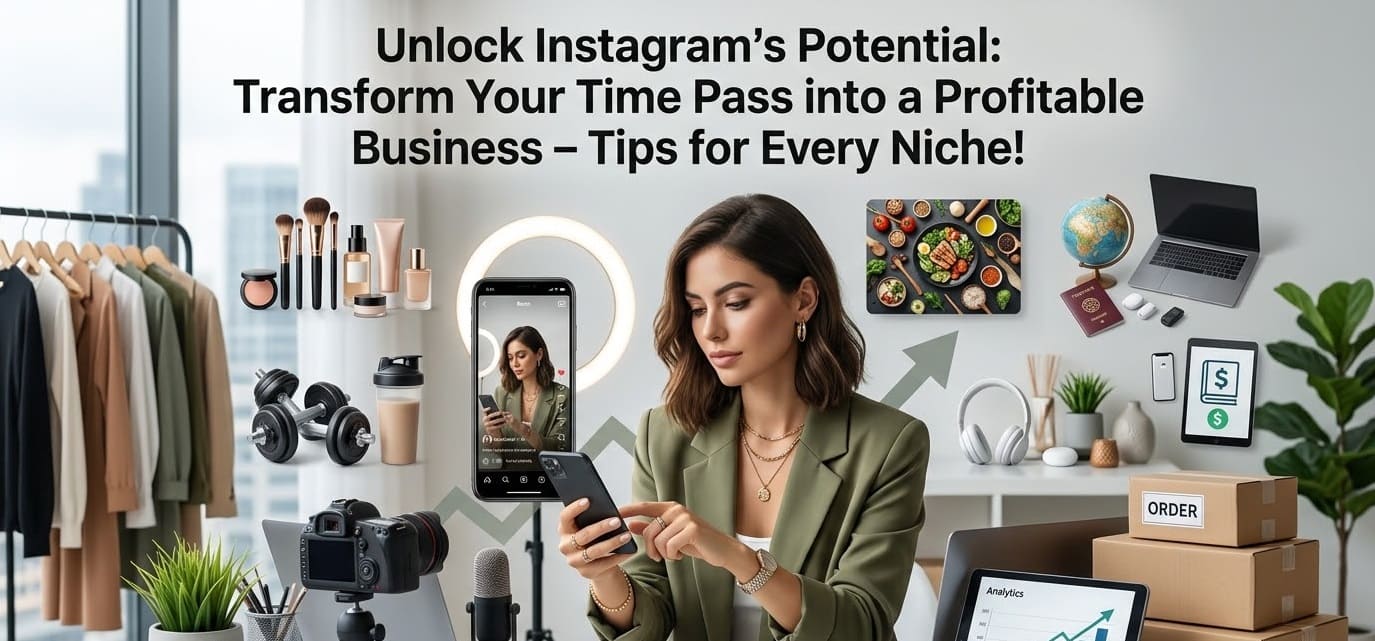
Unlock Instagram’s Potential: Transform Your Time Pass into a Profitable Business – Tips for Every Niche!
📅 Published: September 2026 | ⏱ Reading Time: ~27 Minutes | 🗂 Category: SOCIAL MEDIA TIPS | 👥 For: Beginners, Side Hustlers and Small Business Owners in the USA
Picture an ICU nurse in Phoenix, Arizona. After every night shift she lies in bed and scrolls Instagram for an hour, watching other people’s meal-prep videos. One morning she realizes she has been watching the same kind of content for years. She has a phone, she has recipes of her own, and she has that hour. What if she made one video instead of watching ten?
That’s the shift this guide is about. Many people call their Instagram habit “time pass,” a way to fill idle minutes. The same minutes can become a small business, and the platform is big enough to make that realistic. According to Pew Research Center’s 2025 survey, half of US adults use Instagram, including 80% of adults aged 18 to 29.
Now the honest part. “Profitable” doesn’t mean fast or guaranteed. Average engagement on Instagram runs around 0.5% of followers per post in 2026, Instagram’s own payout tools need at least 500 to 10,000 followers, and brand deals for very small accounts often pay $10 to $100 a post. Nobody can promise you a number. What you can do is learn the steps, test them cheaply, and see what happens.
This guide shows how to turn Instagram into a business in the United States. You’ll get a niche test, profile and search tips, tips for 16 different niches, real dollar ranges, FTC and tax basics, and a 30-day plan you can start this week.
Let’s get into it.
📋 Table of Contents
- Why Instagram Can Become a Real Business (and What Changed)
- Step 1: Pick Your Niche With a Simple Test
- Step 2: Build a Profile That Works Like a Storefront (Instagram SEO)
- Step 3: Content Pillars and Formats That Fit Your Life
- Step 4: Tips for Every Niche (16 Niches)
- Step 5: How to Make Money on Instagram (8 Income Streams)
- Step 6: Reach, Engagement and the Algorithm in 2026
- Step 7: Turn Followers Into Customers
- US Rules Every Instagram Seller Should Know
- Taxes on Instagram Income in the USA
- What It Costs to Start (in Dollars)
- What a Small Account Might Earn (Hypothetical Example)
- Your 30-Day Plan: From Time Pass to Business
- Real Stories: Small Accounts Building Income (Illustrative Examples)
- Red Flags and Mistakes to Avoid
- Free and Paid Tools for Instagram Business
- Quick Reference Checklist
- Frequently Asked Questions (FAQ)
- Final Thought
Why Instagram Can Become a Real Business (and What Changed)
Instagram is one of the few platforms where a stranger can find you, trust you, and pay you inside a few taps. People come to it to discover products, places, and ideas. That’s what makes it useful for a business as well as for entertainment.
It’s also more searchable than it used to be. Since July 2025, public posts from professional Instagram accounts can show up in Google search, as this Instagram search guide explains. That means your caption, alt text, and bio can bring people in from outside the app.
| Who Uses Instagram in the US (Pew, 2025) | Share Who Say They Use It |
|---|---|
| All US adults | 50% |
| Adults 18 to 29 | 80% |
| Adults 30 to 49 | 62% |
| Adults 50 to 64 | 40% |
| Adults 65 and older | 19% |
| Women | 55% |
| Men | 44% |
| Hispanic adults | 62% |
| Asian adults | 58% |
| Black adults | 54% |
| White adults | 45% |
The big picture is that your audience is likely already on the app, and younger adults in particular. The question is what you do with your time there.
The Time Pass Audit: How Many Hours Do You Really Scroll?
Before you plan anything, do the math on your current habit. You may already be spending the hours a side business needs.
| Daily Scrolling | Hours per Week | Hours per Year | Equal to (40-Hour Work Weeks) |
|---|---|---|---|
| 30 minutes | 3.5 | About 182 | About 4.6 |
| 1 hour | 7 | 365 | About 9.1 |
| 2 hours | 14 | 730 | About 18.3 |
You don’t have to quit scrolling. Try trading just 30 minutes a day for creating. That’s 3.5 hours a week, and it’s enough to make three or four posts and answer comments.
What Changes When You Move From Scrolling to Building
| Habit | Time Pass Mode | Business Mode |
|---|---|---|
| What you do | Watch and like | Post, reply, and track |
| Who you follow | Anyone entertaining | Customers, peers, and people in your niche |
| What you save | Random funny posts | Ideas, examples, and hooks to study |
| Goal | Kill time | Help one type of person with one type of problem |
| Money | $0, and the time is gone | Small at first, then possibly real income |
Step 1: Pick Your Niche With a Simple Test
A niche is the specific group you help and the specific thing you help them with. “Fitness” is a topic. “Home workouts for busy moms in the suburbs” is a niche. A clear niche makes every other step easier, from your bio to your first sale.
| Niche Test Question | Good Sign | Warning Sign |
|---|---|---|
| Do you actually enjoy this topic? | You could talk about it for hours | You picked it only because it’s trending |
| Do you know something useful? | Friends already ask you for advice | You’d have to learn everything first |
| Do people pay to solve this problem? | Products, services, or sponsors exist | Nobody seems to spend money on it |
| Can you show it on camera? | You can film it in 15 to 60 seconds | It only works as long text |
| Can you keep going for 12 months? | You have 50+ content ideas | You run out after 10 |
How to Pick a Niche You Won’t Quit
- Write down 10 topics you know or love, then circle the three where you could help someone.
- Search each topic on Instagram and see if small accounts get comments and shares. That signals real demand.
- Check whether brands, products, or services exist in the space, since those are your future income streams.
- Pick one and commit for 90 days. Don’t switch after a week of low views.

Step 2: Build a Profile That Works Like a Storefront (Instagram SEO)
Your profile is your storefront window. People decide in a few seconds whether to follow you. It also acts like a search listing, because Instagram reads your name, bio, captions, and alt text to understand what you post about.
How to Do Instagram SEO in 2026
- Name field. Put your niche and a keyword next to your name, like “Maya | Phoenix Meal Prep.” The name field is searchable text.
- Username. Keep it simple and easy to say out loud.
- Bio. Say who you help, what you help with, and where you are if location matters.
- Captions. Put your main phrase in the first sentence and write naturally after it.
- Alt text. Add one plain sentence describing the image, with a keyword if it fits.
- Hashtags. Use a few relevant ones (three to five). They label your topic and don’t drive reach on their own.
How to Write an Instagram Bio for Business
A strong bio has four parts: who you help, what you help them do, proof or a hook, and one clear next step. Keep it short and specific.
| Niche | Sample Bio Line |
|---|---|
| Fitness | Home workouts for busy moms | 20-minute routines | Free plan below 👇 |
| Local barber | Detroit barber | Fades and beard trims | Book by DM |
| Teacher | Middle school teacher | Classroom tips and printables | Free guide below |
| Handmade goods | Small-batch soy candles from Portland, OR | Ships in 3 days |
| Personal finance | Simple money lessons for new grads | Education, not advice |
Step 3: Content Pillars and Formats That Fit Your Life
Content pillars are the three or four topics you keep coming back to. They keep your account focused and make it easy to think of ideas. For a meal-prep account, the pillars might be recipes, budget tips, time-saving hacks, and behind-the-scenes life.
Different formats do different jobs. Socialinsider’s 2026 data found that Reels reach far more people than other formats, with an average reach rate of about 30.81% compared with 14.45% for carousels and 13.14% for static images. Carousels, on the other hand, tend to earn the highest engagement by followers, at about 0.50%, slightly ahead of Reels at 0.48% and static posts at 0.33%.
| Format | Best For | Strength | Example |
|---|---|---|---|
| Reels | Reaching new people | Highest reach, shown to non-followers | A 30-second recipe or demo |
| Carousels | Teaching and saves | Strong engagement and bookmarks | “5 budget dinners under $10 each” |
| Stories | Daily connection | Low-pressure touchpoint with followers | Polls, behind-the-scenes, Q and A |
| Static posts | Announcements | Simple and quick | A new product photo or a sale |
| Live | Trust and community | Real-time questions | A weekly Q and A |
How to Plan a Week of Instagram Posts
Dash Social’s 2026 benchmarks show growing accounts average about four posts a week. That’s a realistic starting point for a busy person.
| Day | Post | Time Needed |
|---|---|---|
| Monday | Reel: quick tip or demo | 30 to 45 minutes |
| Wednesday | Carousel: teach one idea in 5 to 7 slides | 30 to 45 minutes |
| Friday | Reel: behind-the-scenes or a customer question | 20 to 30 minutes |
| Sunday | Stories: poll, Q and A, or a peek at next week | 10 minutes |
| Daily | Reply to comments and DMs | 5 to 10 minutes |
That totals about 3 to 4 hours a week, which is close to the scrolling time you saved in the audit above.
Step 4: Tips for Every Niche (16 Niches)
Every niche has its own content style, income path, and rules. Use the tables below as a starting point, then adapt to your own voice. Where a rule is mentioned, check the official source for your state, since rules vary.
Group A: Health, Food and Lifestyle
| Niche | Content Ideas That Work | Best Ways to Earn | US Tip or Rule |
|---|---|---|---|
| Fitness and wellness | Short routines, form checks, weekly challenges | Coaching, digital plans, affiliate gear | Avoid medical claims and add a “not medical advice” note |
| Food and home cooking | Quick recipes, budget meals, kitchen hacks | Affiliate cookware, recipe ebooks, sponsors | Selling home-made food is regulated by state cottage food laws |
| Beauty and skincare | Before and after, routines, honest reviews | Affiliate links, brand deals, UGC work | Disclose free products and don’t exaggerate results |
| Parenting and family | Real-life tips, product tests, routines | Sponsors, affiliate, printables | Be careful posting children’s photos and private details |
| Pets | Training tips, product tests, funny moments | Affiliate, sponsors, digital guides | Only recommend products you have actually used |
| Travel | Weekend trips, budget itineraries, hidden gems | Affiliate, tourism partnerships, guides | Disclose hosted trips and free stays |
Group B: Money, Career and Learning
| Niche | Content Ideas That Work | Best Ways to Earn | US Tip or Rule |
|---|---|---|---|
| Personal finance (education) | Budgeting tips, saving challenges, explainers | Digital products, sponsors, affiliate | Teach general education and avoid personalized investment advice |
| Coaching and careers | Resume tips, interview practice, career stories | Coaching, templates, workshops | Don’t promise results, including jobs or income |
| Teaching and tutoring | Study tips, mini lessons, printables | Printables, tutoring, courses | Avoid sharing student information |
| Tech and AI tools | Tool demos, shortcuts, tutorials | Affiliate, sponsors, services | Disclose sponsorships and free access |
| Real estate and home | Local tours, staging tips, DIY fixes | Leads, services, sponsors | Check state licensing rules before offering services |
Group C: Creative and Local
| Niche | Content Ideas That Work | Best Ways to Earn | US Tip or Rule |
|---|---|---|---|
| Art and handmade goods | Process videos, packing orders, studio tours | Product sales, commissions, prints | Track sales tax and business license rules by state |
| Fashion and thrift | Outfit ideas, thrift hauls, styling | Resale, affiliate, sponsors | Disclose brand relationships and gifted items |
| Photography and video | Before and after edits, behind the scenes | Client work, presets, prints | Get releases when you photograph people commercially |
| Local services (barber, cleaner, contractor) | Job results, tips, before and after | Bookings through DMs | Show your license number where your state requires it |
| Cafes and restaurants | Behind-the-scenes, menu reveals, staff stories | Foot traffic, catering, events | Follow local health rules when showing kitchens |
One Rule for Every Niche
Teach or show something useful in the first three seconds, in your own voice. Whatever your niche, the accounts that grow are the ones that help somebody clearly and consistently.
Step 5: How to Make Money on Instagram (8 Income Streams)
Instagram doesn’t pay creators from a single fund the way some platforms do. Income comes from a stack of separate sources. Some need follower minimums. Most don’t. Here’s the overview, based on 2026 guides. Requirements change often, so confirm your own eligibility in the Professional Dashboard under Monetization, as this monetization requirements guide recommends.
| # | Income Stream | Entry Bar | What the Sources Suggest | Time to First Dollar (Estimate) |
|---|---|---|---|---|
| 1 | Affiliate links | None. Amazon Associates is free to join | Roughly 1% to 10% commission at Amazon, by category | 1 to 3 months |
| 2 | Brand deals and sponsorships | No official minimum | Nano accounts often $10 to $100 a post, micro accounts $100 to $500 or more | 3 to 9 months |
| 3 | Gifts on Reels | Commonly cited around 500 followers, professional account, age 18+ | Small tips from fans. Not a main income | 2 to 6 months |
| 4 | Subscriptions and Live Badges | Around 10,000 followers, professional account, age 18+ | Monthly fan payments. Varies by audience | 9 to 18 months |
| 5 | Your own products (physical) | None, but you need a store | You set the price. See the profit math below | 1 to 3 months |
| 6 | Digital products and services | None | You keep about 80% to 95% after fees | 1 to 3 months |
| 7 | UGC creator work (making content for brands) | None | Per video, set by you. Small starter rates are common | 1 to 3 months |
| 8 | Managing Instagram for local businesses | None | Some 2026 guides list monthly retainers of about $250 to $2,000 | 1 to 3 months |
Timelines are rough estimates, not guarantees. Instagram’s invite-only bonus programs have no public threshold, so don’t plan around them.
How to Make Money on Instagram With 1,000 Followers
You can’t use Subscriptions yet, but you can start earning. Affiliate links, UGC work, small brand deals, digital products, and local services have no follower minimum. A small account with real engagement often converts better than a bigger account that’s gone quiet. So focus on helping people in your comments and DMs, and pitch a few small brands directly.
How Much Do Small Instagram Accounts Charge for Sponsored Posts?
According to Influencer Marketing Hub’s 2026 rate guide, nano accounts (under 10,000 followers) typically charge about $10 to $100 per post, and micro accounts (10,000 to 100,000 followers) commonly charge $100 to $500 for a feed post. Other 2026 guides list higher ranges, up to $5,000 for micro accounts, so treat these as rough. Reels often cost more than static posts, and Stories usually cost less. Many nano deals pay in free products.
| Account Size | Typical Rate Range Per Feed Post (One 2026 Guide) | Notes |
|---|---|---|
| Nano (1,000 to 10,000 followers) | $10 to $100 | Often paid in gifted products |
| Micro (10,000 to 100,000 followers) | $100 to $500 | Other guides list up to $5,000 |
| Mid-tier (100,000 to 500,000 followers) | $500 to $5,000 | Structured rate cards |
Whatever you charge, disclose every paid or gifted post clearly. More on that in the rules section.
Step 6: Reach, Engagement and the Algorithm in 2026
Instagram’s head, Adam Mosseri, said in early 2025 that the top ranking signals are watch time, likes per reach, and sends per reach. Likes count a bit more for people who already follow you, and sends count more for reaching new people. So the best posts are ones people finish, enjoy, and forward to a friend.
- Reels can run up to three minutes, but shorter clips often earn more reach.
- Original content wins. Accounts made mostly of other people’s content stop being recommended.
- Clear topics help. Use plain words in captions so Instagram understands what your post is about.
- Hashtags are labels, not magic. A few relevant ones are enough.
What Is a Good Instagram Engagement Rate in 2026?
The answer depends on how it’s measured. Measured against followers, 2026 benchmarks put the average around 0.3% to 0.5%, and small accounts often run much higher. Measured against reach or views, the numbers are higher. Compare yourself against your own last month, not against a stranger’s screenshot.
| Measure | Typical 2026 Range | What It Means |
|---|---|---|
| Engagement by followers (all accounts) | About 0.3% to 0.5% | Three to five interactions per 1,000 followers |
| Engagement by followers (accounts under 10,000) | Often several times higher | Small, close communities engage more |
| Engagement by views or reach | Roughly 1.9% to 3.5% | Higher because it divides by a smaller number |
Step 7: Turn Followers Into Customers
Followers are attention. Customers are people who take one action. The path is short: a viewer sees a post, checks your profile, taps your link or sends a DM, and buys. Each step can leak, so make each one easy.
| Funnel Step | What to Do | What to Track |
|---|---|---|
| Post | Solve one small problem clearly | Views, sends, saves |
| Profile | Bio says who you help, with one link | Profile visits |
| Link | Send people to a booking page, store, or email sign-up | Link clicks |
| DM | Reply quickly and ask one helpful question | Conversations started |
| Sale | Make checkout simple and honest | Orders and revenue |
One note for sellers: Meta moved Instagram and Facebook shops to website checkout during 2025. You can still tag products in Reels and posts, but buyers finish the purchase on your own site.
How to Get Clients From Instagram DMs
- Reply within a day, even if it’s a short answer.
- Ask one question to understand what the person needs.
- Offer one clear next step: a booking link, a price, or a sample.
- Keep a saved list of your common answers so replies take a minute.
- Follow up once. Don’t spam.
US Rules Every Instagram Seller Should Know
Making money on Instagram brings real legal duties. None of them are hard, but ignoring them can be expensive.
| Topic | What to Know | What to Do |
|---|---|---|
| Sponsored posts and free products | The FTC’s Disclosures 101 for Social Media Influencers says you must disclose any material connection to a brand, including free products. It’s your responsibility, and disclosures must be hard to miss and not buried in a bio or behind a “more” tap | Use Instagram’s Paid Partnership label and say “ad” or “sponsored” clearly in the post |
| Tags and likes | The FTC counts tags, likes, and pins that show you like a brand as endorsements | Disclose those relationships too |
| Fake followers and reviews | The FTC’s review rule (16 CFR Part 465) bans fake reviews and buying fake followers to look bigger | Grow honestly |
| Earnings claims | False or exaggerated income claims are illegal in ads and courses | Never promise results in your posts |
| Product claims | You need proof for health and performance claims | Say only what you can support |
| Kids and privacy | Be careful sharing children’s photos or details, and follow Instagram’s age rules | Get consent and avoid private information |
| Selling food, goods or services | Cottage food laws, licenses and sales tax rules vary by state | Check your state and local rules before you sell |
Taxes on Instagram Income in the USA
The IRS treats creator and side hustle income as self-employment income. This CPA guide for content creators covers the current thresholds and forms.
| Topic | What to Know | What to Do |
|---|---|---|
| Filing threshold | Net self-employment earnings of $400 or more generally mean you must file and pay self-employment tax | Track income and expenses from your first dollar |
| Self-employment tax | 12.4% Social Security (up to $184,500 of earnings for 2026) plus 2.9% Medicare, after multiplying net profit by 92.35% | Report on Schedule SE with your Form 1040 |
| Where it goes | Brand deals, affiliate commissions, product sales and service income all count. Expenses go on Schedule C | Keep receipts for gear, software, and fees |
| Gifted products | Free products can count as income in some situations | Ask a tax professional how to treat them |
| 1099 forms | For 2026 payments, many business payments need a form only at $2,000 or more. The 1099-K threshold returned to more than $20,000 and more than 200 transactions | Report all income anyway. No form doesn’t mean no tax |
| Estimated payments | Generally required if you expect to owe $1,000 or more. The next 2026 tax-year deadline is January 15, 2027 | Many creators set aside about 25% to 30% of each payment |
| State taxes | Vary by state. Texas and Florida have no state income tax. California and New York do | Check your state’s revenue department |
Taxes on Instagram Income in the USA: A Simple Habit
Keep one spreadsheet with a row for every payment: date, source, amount, and fees. Open a separate savings account for taxes and move a fixed percentage into it after every payout. If your income grows, talk to a tax professional. This is general information, not personal tax advice.
What It Costs to Start (in Dollars)
You can start with a phone and a free account. The estimates below are rough and vary by product and store.
| Item | Beginner Cost (Estimate) | Notes |
|---|---|---|
| Phone camera | $0 (the one you own) | Good light matters more than a new camera |
| Lighting | $0 to $60 | A window works for many creators |
| Microphone (optional) | $25 to $100 | Helpful for talking videos |
| Canva | $0, or roughly $12 to $18 a month for Pro | Covers, carousels, and quick edits |
| Editing app | $0 | Free versions are enough to start |
| Scheduling | $0 | Meta Business Suite is free |
| Digital product platform | 10% plus $0.50 per sale at Gumroad. 5% on shop sales at Ko-fi (free plan) | Card processing (about 2.9% plus $0.30) is charged on top |
| Tax set-aside | About 25% to 30% of income | A common rule of thumb |
Business Setup Costs by US State (City Examples)
You don’t need an LLC to start. Many US creators begin as sole proprietors and form a business later. If you do form one, state fees differ. These figures come from 2026 state fee guides, so confirm them on your Secretary of State’s website.
| City | State Income Tax | LLC Formation Fee (State Filing) | Extra Costs to Know |
|---|---|---|---|
| Austin, Texas | None | About $300 | Some filings may need a notary ($2 to $16 per signature) |
| Tampa, Florida | None | $125 to $175 | Annual report required, with penalties for missing it |
| Denver, Colorado | Yes | About $50 | Annual report fee applies |
| Sacramento, California | Yes (1% to 13.3%) | About $70 | Minimum $800 annual franchise tax for most LLCs |
| New York, New York | Yes (4% to 10.9%) | State filing fee | Publication in newspapers can add $500 to $1,200 |
What a Small Account Might Earn (Hypothetical Example)
This is a made-up example built from the ranges above. It is not a forecast and not a real person.
Imagine a 5,000-follower account in the meal-prep niche after a year of steady posting. Here’s one plausible month.
| Income Stream | Assumption | Monthly Result |
|---|---|---|
| Brand deal | One small paid post at $150 | $150 |
| Affiliate links | $1,500 in sales at 4% commission | $60 |
| Digital product | 20 sales of a $12 planner, after Gumroad and card fees | About $193 |
| UGC video | One video for a small brand | $75 |
| Gifts on Reels | Small fan tips | $20 |
| Total | About $498 |
That’s about $498 a month before taxes, roughly $374 after setting aside 25%. It’s a side income, not a salary. It also took a year of steady work. But notice how five small streams add up, and how no single one carries everything.
Your 30-Day Plan: From Time Pass to Business
- Days 1 to 3: Audit and choose. Do the scrolling audit, then pick one niche with the test above.
- Days 4 to 7: Set up your profile. Switch to a professional account, write a keyword-rich name and bio, and add one link.
- Days 8 to 14: Post four times a week. Mix two Reels, one carousel, and daily Stories. Reply to every comment.
- Days 15 to 21: Add one income path. Choose affiliate links, a small digital product, or a service, and mention it once a week.
- Days 22 to 25: Start conversations. Answer DMs, comment on other accounts in your niche, and message two or three small local brands.
- Days 26 to 28: Set up records. Open a spreadsheet for income and expenses, and a separate savings account for taxes.
- Days 29 to 30: Review. Check which posts got the most sends and saves, and plan the next month around them.
Thirty days can show you whether you enjoy this and where your first audience comes from. That’s valuable information before you spend real money.
Real Stories: Small Accounts Building Income (Illustrative Examples)
These are made-up examples based on common patterns. They are not real people or real results.
Story 1: Brianna, 32 — ICU Nurse, Phoenix, Arizona
Brianna posted three short meal-prep videos a week for her night-shift lifestyle. She earned $35 from affiliate links in month four and reached about 4,800 followers by month ten. She then sold a $12 meal-prep planner, and 20 sales left her about $193 after fees. She put 25% of every payment into a separate tax savings account.
Story 2: Marcus, 27 — Barber, Detroit, Michigan
Marcus put “Detroit barber” in his name field and bio and posted before-and-after Reels. New clients began booking by DM. He gained about six new customers a month at $35 a cut, roughly $210 in added income. He says the search-friendly bio did more than any hashtag.
Story 3: Elena, 41 — Middle School Teacher, Portland, Oregon
Elena posted carousels with classroom tips and sold printable worksheets at $8 each. Forty sales in a busy back-to-school month brought in $320 in gross sales. She used Ko-fi’s free plan and kept about 95% before card fees, and she never joined a paid course.
Story 4: Jordan, 23 — College Student, Atlanta, Georgia
Jordan made honest product-test Reels and messaged small brands directly. His first paid post was $50, and he labeled it as a paid partnership. A few months later he charged $120 for a short video package. He set aside $12.50 from that first $50 for taxes, which is 25%.
Red Flags and Mistakes to Avoid
- Promises of guaranteed or fast income. No honest teacher can guarantee earnings, and the FTC treats exaggerated income claims as a serious problem.
- Buying followers or engagement. It breaks Instagram’s rules and the FTC’s review rule.
- Follow-for-follow tricks. They fill your account with people who will never buy.
- Not disclosing sponsored or gifted posts. It’s your responsibility, not the brand’s.
- Copying other people’s Reels. Original content is what Instagram recommends.
- Jumping between niches. A clear topic helps both people and search.
- Paying for a course before testing anything. Spend nothing until you know you enjoy it.
- Health, money and career claims you can’t prove. Keep it educational.
- Ignoring taxes. Every source of income is taxable, even without a form.
Free and Paid Tools for Instagram Business
| Tool | What It Does | Free or Paid? | Why You Need It |
|---|---|---|---|
| Instagram professional account | Insights, monetization dashboard | ✅ Free | Required for most business tools |
| Meta Business Suite | Scheduling and analytics | ✅ Free | Plan posts in advance |
| Canva | Covers, carousels, quick edits | ✅ Free plan, Pro roughly $12 to $18/month | Consistent visuals fast |
| Free video editors | Cutting clips and captions | ✅ Free versions available | Edit Reels on your phone |
| Google Trends | Search interest over time | ✅ Free | Find topics people search for |
| Amazon Associates | Affiliate links | ✅ Free to join | Commissions on products you recommend |
| Gumroad or Ko-fi | Sell digital products | Gumroad 10% plus $0.50 per sale. Ko-fi free plan takes 5% on shop sales | Simple checkout for guides and printables |
| Google Sheets | Income, expenses, content plan | ✅ Free | Keeps tax records ready |
✅ Quick Reference Checklist — Your Action Plan
| ☐ | Action Step | Priority | When to Do It |
|---|---|---|---|
| ☐ | Do the scrolling audit and pick 30 minutes a day to create | 🔴 Critical | Today |
| ☐ | Pick one niche using the test | 🔴 Critical | This week |
| ☐ | Switch to a professional account and write a keyword-rich bio | 🔴 Critical | This week |
| ☐ | Post four times a week for four weeks | 🟠 High | Weeks 2 to 5 |
| ☐ | Add alt text and 3 to 5 relevant hashtags to each post | 🟠 High | Every post |
| ☐ | Reply to every comment and DM | 🟠 High | Daily |
| ☐ | Add one income path (affiliate, product, or service) | 🟠 High | Weeks 3 to 4 |
| ☐ | Learn the FTC disclosure rules and use the Paid Partnership label | 🟡 Medium | Before your first sponsored post |
| ☐ | Open a spreadsheet for income and expenses | 🟡 Medium | Week 1 |
| ☐ | Set aside 25% to 30% of income for taxes | 🟡 Medium | From your first payment |
| ☐ | Review results at day 30 and adjust | 🟡 Medium | Day 30 |
Frequently Asked Questions (FAQ)
1. Can you really turn your Instagram time pass into a profitable business?
It’s possible, but it’s not guaranteed, and it usually takes months of steady work. Many people earn small amounts at first, from affiliate links, small brand deals, digital products, or local services. Instagram’s own payout tools need 500 to 10,000 followers, and income varies widely. Treat it like a side business you build slowly, not a shortcut.
2. How many followers do I need to make money on Instagram?
There is no single number. Gifts on Reels are commonly cited at around 500 followers, and Subscriptions and Live Badges at about 10,000, with a professional account and age 18 or older. Affiliate links, UGC work, digital products, local services, and many small brand deals have no follower minimum. Check your own eligibility in the Professional Dashboard under Monetization.
3. How much do small Instagram accounts make per sponsored post in the USA?
One 2026 rate guide puts nano accounts (under 10,000 followers) at about $10 to $100 per post, and micro accounts (10,000 to 100,000 followers) at $100 to $500. Other guides list higher ranges, up to $5,000 for micro accounts. Many small deals pay in free products. Always disclose paid and gifted posts clearly.
4. Does Instagram pay per view?
Not in a single, public way like some platforms. Instagram’s income tools are separate: Gifts, Subscriptions, Live Badges, and invite-only bonus programs with no public threshold. Most creator income comes from brand deals, affiliate links, and selling your own products or services.
5. What is the best niche for beginners on Instagram?
The best niche is one you enjoy, know something useful about, and can show in short videos. Fitness, food, beauty, parenting, pets, education, handmade goods, and local services are all workable. Use the niche test in this guide, and commit for at least 90 days before changing.
6. How often should I post on Instagram?
Growing accounts average about four posts a week in 2026 benchmarks, which is a realistic start for a busy person. A mix of two Reels, one carousel, and daily Stories works well. Keep the pace you can hold for a year, and let your analytics show what your audience likes.
7. Do I have to pay taxes on Instagram income in the US?
Generally yes. The IRS treats creator income as self-employment income, and net earnings of $400 or more in a year create a filing requirement. You report income on Schedule C and pay self-employment tax of 15.3% on net profit, after the standard adjustment. State rules differ. This is general information, not tax advice.
8. Do I have to disclose ads and affiliate links on Instagram?
Yes. The FTC requires you to disclose any material connection to a brand, including free products, payment, and affiliate commissions. The disclosure must be clear and hard to miss, and it should be in the post itself, not only in your bio. Use Instagram’s Paid Partnership label and words like “ad” or “sponsored.”
Final Thought
If you’re a nurse in Phoenix, a barber in Detroit, a teacher in Portland, or a student in Atlanta, you already own the two things this needs: a phone and a few spare hours. The difference between scrolling and building is what you do with them.
Your first posts won’t look perfect, and your first weeks may bring almost nothing. That’s normal. Pick a niche, help one type of person, and keep the habit for a few months. The accounts that grow are usually the ones that kept showing up.
Be honest with your audience, disclose every sponsorship, and keep every payment on a simple spreadsheet. Set aside a share for taxes from your first dollar. Those habits don’t sound exciting, but they keep a small business alive.
Then be patient. A creator in Austin, Tampa, or Denver starts from the same place as everyone else: one post, one follower, one small win. The next one builds on it.
Recap: Audit your time ✅ Pick one niche ✅ Optimize your profile ✅ Add income streams slowly ✅ Follow the rules and track taxes ✅
Now it’s time to take action and get started today! 🚀
Found this guide useful? Share it with a friend who scrolls Instagram every day.
Disclaimer: Earnings, rates and timelines mentioned here are ranges from published sources and are not guarantees. Platform rules, thresholds and fees change often, so confirm current details with Instagram and your state. Tax and legal information is general and not personal advice.