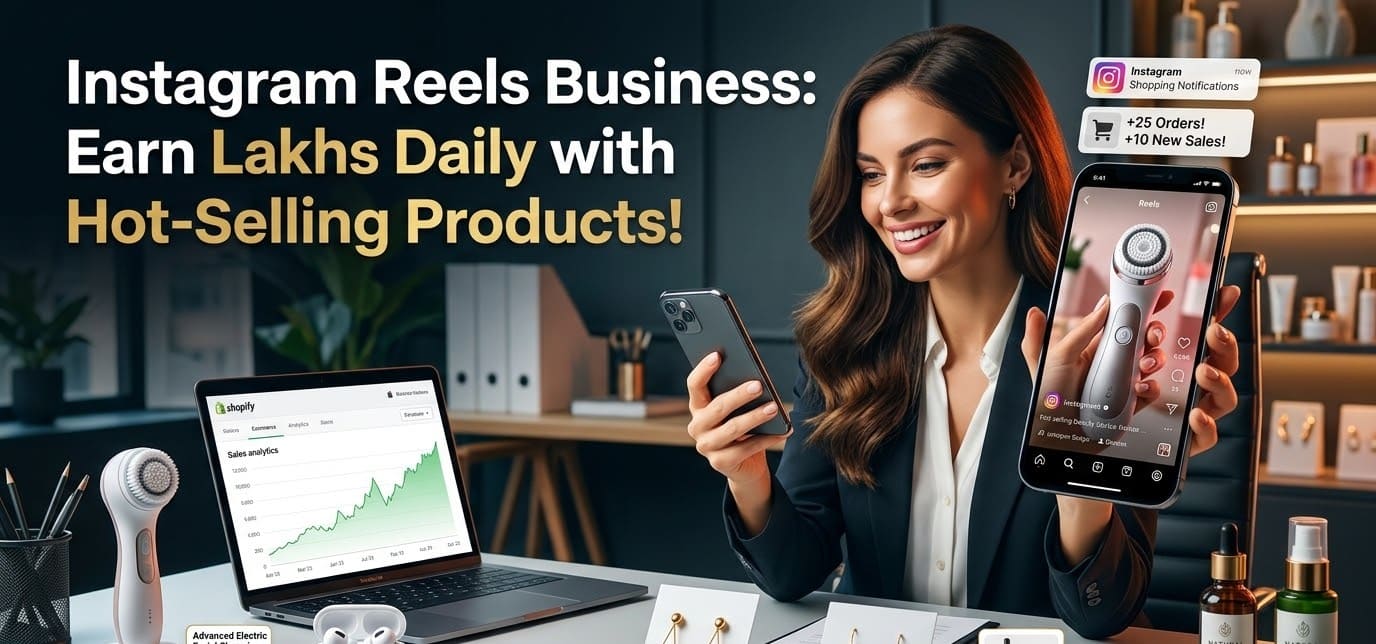
Instagram Reels Business: Earn Lakhs Daily with Hot-Selling Products!
📅 Published: September 2026 | ⏱ Reading Time: ~27 Minutes | 🗂 Category: ONLINE BUSINESS | 👥 For: Beginner Sellers and Creators in the USA
Picture a stay-at-home dad in Charlotte, North Carolina. He films a 25-second Reel of a $24 pet hair remover working on a couch, taps a product tag, and posts it. Three days later a stranger in Phoenix sends that Reel to a friend with a dog. Two orders arrive over the weekend. That’s what a small Instagram Reels business looks like. No magic, just a good video reaching the right person.
Instagram gives that video a real chance. Its head, Adam Mosseri, said in January 2025 that watch time, likes, and sends are the top ranking signals, and Reels can now run up to three minutes. But one thing changed that many old tutorials miss. Meta moved US shops to website checkout during 2025, so buyers now finish their purchase on your own site.
A word on the promise you may have seen elsewhere: “earn lakhs daily.” Nobody can guarantee that. The FTC has told businesses that false or exaggerated earnings claims are illegal, and honest teachers don’t make them. This guide uses US dollars, real math, and US rules instead, so you can see what one sale actually leaves in your pocket.
Here’s a number to keep in mind. Online stores usually turn about 1% to 3% of visitors into buyers, and one 2026 benchmark report put the median conversion rate for ecommerce on Meta at 1.57%. On a $29.99 product with normal costs, that math decides everything. Margins matter as much as views.
This guide walks you through building an Instagram Reels business in the United States: picking products, making Reels that sell, setting up a store, following FTC rules, paying taxes, and avoiding the traps that catch beginners.
Let’s get into it.
📋 Table of Contents
- Why an Instagram Reels Business Works (and What Instagram Changed)
- Business Model 1: Sell Your Own Products Through a Store
- Business Model 2: Affiliate Products
- Business Model 3: Dropshipping and Print-on-Demand
- Business Model 4: Private Label, Handmade and Local Products
- Business Model 5: Digital Products and Services
- Business Model 6: Brand Deals
- How to Find Hot-Selling Products (Without Chasing Fads)
- The Real Math: What One Sale Actually Earns
- How to Make Reels That Sell
- From Reel to Sale: Setting Up Your Store and Costs
- US Rules Every Product Seller Must Know
- Taxes for Instagram Sellers in the USA
- Realistic Income Comparison: All 6 Business Models
- Your 90-Day Step-by-Step Plan
- Are You Ready to Launch? A Simple Decision Test
- Real Stories: Small Reels Sellers (Illustrative Examples)
- Red Flags and Mistakes to Avoid
- Free and Paid Tools for Reels Sellers
- Quick Reference Checklist
- Frequently Asked Questions (FAQ)
- Final Thought
Why an Instagram Reels Business Works (and What Instagram Changed)
Reels are built for products. A 20-second video can show a problem, a solution, and a result faster than a photo ever could. Buyers see the product move, hear you explain it, and decide in a few seconds whether they want it. That’s hard to do with a static listing.
Reels also travel. Instagram recommends good Reels to people who don’t follow you yet, which means a small account with a strong video can still reach new buyers. Small accounts have to earn that reach with watch time and shares, but the door is open.
What You Gain From a Reels-Based Business
- ✅ Low startup cost. A phone, a product, and a store link can be enough to test an idea.
- ✅ Free discovery. Good Reels reach new people without ad spend.
- ✅ Fast feedback. You see within days which products people save and send.
- ✅ Real brand control. Selling from your own store keeps your customer list.
- ✅ Several ways to earn. Products, affiliate links, services, and sponsorships all fit the same account.
- ✅ Skills that carry over. Filming, editing, and writing hooks help every other online business.
Three Ways to Sell Off a Reel
| Factor | Your Own Store (Reels + Product Tags) | TikTok Shop | Affiliate Links |
|---|---|---|---|
| Where buyers pay | On your website | Inside the TikTok app | On the retailer’s site |
| Startup cost | $5 to $39 a month for a store, plus products | Low, plus products | $0 |
| Control of brand and customers | ✅ High | Medium | ❌ Low |
| Profit per sale | You set the price | Depends on category fees | Commission, often 1% to 10% at Amazon |
| Best for | Building a real brand | Impulse-priced products | Testing what your audience wants |
What Instagram Changed (and Why Old Tutorials Are Wrong)
If you follow an old guide, you’ll hit a wall. In 2025, Meta moved Facebook and Instagram shops to website checkout, so customers now finish purchases on the seller’s own site. Meta also stopped handling order management, returns, and disputes inside its apps.
- In-app checkout is gone for US merchants. Buyers tap a product tag and land on your website.
- The Shop tab left Instagram’s main navigation back in February 2023.
- Live Shopping with in-stream product tags was discontinued.
- Product tags in Reels, posts and Stories still work, and Reels tags do especially well.
- You need a connected product catalog and a store that can take payments.
Business Model 1: Sell Your Own Products Through a Store
This is the classic setup. You list products on a store, tag them in your Reels, and send buyers to checkout on your site. You control the price, the brand, and the customer list. You also handle shipping, returns, and support, so choose products you can actually fulfill.
| Store Option | Monthly Cost | Card Processing | Best For |
|---|---|---|---|
| Shopify Starter | About $5 | Higher rate, around 5% plus $0.30 | Testing with a link, not a full storefront |
| Shopify Basic | $39 ($29 a month if billed yearly) | 2.9% plus $0.30 online | A first real store |
| Shopify Grow | $105 ($79 a month if billed yearly) | 2.7% plus $0.30 online | Stores with steady sales |
Shopify has offered a short free trial followed by an introductory $1-a-month period for new stores. Offers change, so check the current deal. One guide puts a realistic all-in budget for a new store at $30 to $100 a month once you add a theme, apps, and a domain.
How to Use Instagram Product Tags in Reels
- Switch to a professional (business or creator) Instagram account.
- Connect a Facebook Page and create a product catalog in Meta’s Commerce Manager. Shopify can sync this for you.
- Publish a clear returns policy and reply to buyer messages. Accounts that ignore inquiries risk losing shopping access.
- When you post a Reel, tap “Tag products” and choose an item from your catalog.
- Send viewers to your checkout page, and track which Reels produce clicks.
Business Model 2: Affiliate Products
Affiliate marketing lets you recommend products from other companies and earn a commission on sales. You don’t ship anything or handle returns. The trade-off is low pay per sale. Amazon Associates is the best-known US program, and it’s free to join.
| Amazon Associates Detail | What to Know |
|---|---|
| Commission rates | Roughly 1% to 10% by category, with a few categories higher. The rate follows the category of what the buyer purchases |
| Cookie window | 24 hours. Items added to the cart can keep credit longer, up to about 90 days |
| Qualifying sales | You need 3 qualifying sales within 180 days or Amazon can close the account |
| Payment | Direct deposit, with a $10 minimum in most reports |
| Disclosure | You must clearly say you earn from qualifying purchases |
A simple example: you recommend a $40 kitchen gadget at a 3% commission. That’s $1.20 a sale, so 100 sales earn $120. It’s slow money, but it costs nothing to test which products your viewers want.
How to Make Money on Instagram Reels Without Your Own Products
- Show a product in use, then put the link in your bio or send it by DM when people comment.
- Say the disclosure on screen and in the caption every time.
- Recommend only what you have actually used.
- Use affiliate results as market research before you invest in inventory.
Business Model 3: Dropshipping and Print-on-Demand
Dropshipping means a supplier ships the product to your customer after you sell it. Print-on-demand works the same way for items like shirts and mugs. You don’t hold inventory, so the startup cost is low. The problems come after the sale: slow shipping, thin margins, and returns you still have to handle.
| Factor | Dropshipping / Print-on-Demand | What It Means for You |
|---|---|---|
| Startup cost | ✅ Low | A store and a few samples can be enough |
| Profit per order | ❌ Thin | Often $5 to $15 on a $30 item after costs (example) |
| Shipping time | ❌ Often slow | The FTC 30-day rule still applies to you |
| Customer service | On you | Complaints about late orders land on your account |
| Control over quality | ❌ Low | You often can’t inspect products before they ship |
Is Dropshipping Still Worth It in 2026?
It can work as a test, not as a get-rich plan. Margins are thin, so paid ads rarely pay for themselves (you’ll see the math below). Many sellers use it to find which products get sends and saves, then move to products they can source with better quality and margin.
Business Model 4: Private Label, Handmade and Local Products
This model earns the best margins, and it fits Reels perfectly. Making, packing, or customizing a product gives you endless footage: the pour, the stitch, the finished order. Viewers love watching things get made, and they trust a real person.
| Example Product (Illustrative) | Price | Total Cost per Item | Profit per Item |
|---|---|---|---|
| Soy candle (handmade) | $28 | About $11 (materials, packaging, shipping, fees) | About $17 |
| Grooming kit (assembled) | $15 | About $8 | About $7 |
| Custom pet bandana | $18 | About $7 | About $11 |
These are made-up examples to show how margins work. Your costs will differ, so calculate your own before you price anything.
The catch is inventory. You pay for materials or stock before you sell. Start with a small batch, test with real orders, and reorder only when Reels prove people want it.
Business Model 5: Digital Products and Services
Digital products have no shipping and no stock. Think templates, checklists, presets, short guides, or a mini course. Services, like editing Reels for local businesses, use the skill your account already shows off.
| Option | Fees or Cost | Notes |
|---|---|---|
| Gumroad | 10% plus $0.50 per direct sale | Card processing (about 2.9% plus $0.30) is charged on top |
| Ko-fi (free plan) | 0% on tips, 5% on shop sales | Processing fees apply |
| Services (like Reel editing for local shops) | Your time | Example: 3 hours at $40 an hour is $120 a package |
On a $19 template pack sold through Gumroad, the platform fee is about $2.40 and card processing is about $0.85, so you keep roughly $15.75. Fees change, so check each platform before you choose.
Business Model 6: Brand Deals
Once your Reels reach a steady audience, brands may pay you to feature their products. Meta’s Creator Marketplace connects brands with creators for paid partnerships. Rates vary a lot, so price by expected views instead of follower count. A common method is average views times a CPM (cost per 1,000 views) divided by 1,000.
| Brand Deal Checklist | Why It Matters |
|---|---|
| Ask for the brief in writing | You avoid surprises about what you must say and show |
| Use the paid partnership label | The FTC requires clear disclosure of sponsorships |
| Know the usage rights | Brands may want to reuse your Reel in ads, which is worth more money |
| Set payment terms up front | Get paid on a date, not “when the campaign ends” |
| Only promote what you would use | Your audience’s trust is your real asset |
How to Find Hot-Selling Products (Without Chasing Fads)
Specific viral products rotate every few weeks. Categories don’t. The safest plan is to pick a category that suits video, then test a few products inside it. TikTok Shop is the biggest public window into short-video shopping in the US. Estimates put its US sales at roughly $15 billion in 2025, and the same category patterns show up on Reels.
| Category | Rough Share of TikTok Shop US Sales (Estimates) | Why It Works on Video | Watch Out For |
|---|---|---|---|
| Beauty and personal care | About 22% to 25% | Before-and-after results show in seconds | Ingredient and health claims need proof |
| Fashion and accessories | About 15% to 20% | Try-ons and styling clips build social proof | Sizing problems and returns |
| Home and kitchen | About 15% | Problem-and-solution gadgets are easy to demo | Poor quality leads to returns |
| Health and wellness | About 11% | Clear routines and results content | Strict rules on supplement claims |
| Pet products | Smaller but steady | Pet owners share and save helpful videos | Product safety |
| Fitness and outdoor | Growing | Demonstrations and gear reviews | Bulky items raise shipping costs |
Share figures come from third-party estimates and differ by source. Treat them as directional.
The Product Scorecard
| Test | Good Sign | Warning Sign |
|---|---|---|
| Price | $15 to $40, the range that sells most on short-video platforms | Under $10 (no margin) or over $80 (slow decision) |
| Demo | The benefit shows in 15 to 60 seconds | You need a long explanation |
| Profit | At least about $10 left after all costs (a rule of thumb) | Under $5 after shipping and fees |
| Returns | Simple product, clear sizing or use | Fragile, sized, or easy to break |
| Shipping | Arrives within your promised time | Long or unreliable delivery |
| Claims | You can prove what you say | You’d have to exaggerate to sell it |
How to Test a Product Before You Buy Inventory
- Order one sample and use it yourself for a week.
- Film five different Reels for the same product with different hooks.
- Watch sends and saves first. Sends show that people want to share it.
- If the Reel gets sends but no clicks, fix the link and the call to action.
- If nobody sends it, fix the first three seconds or pick another product.
Where to Find Product Ideas
- Your own daily problems and the ones your friends complain about.
- Comments on popular Reels in your niche. People say what they want.
- Google Trends, to see whether interest is rising or fading.
- Amazon best-seller lists, to see what already sells at your price point.
The Real Math: What One Sale Actually Earns
This is the section most “hot product” videos skip. Here’s a realistic example using a $29.99 product sold through a store on Shopify Basic.
| Item | Amount |
|---|---|
| Selling price | $29.99 |
| Product cost | −$9.00 |
| Shipping to the customer | −$5.00 |
| Card processing (2.9% plus $0.30) | −$1.17 |
| Profit per order before ads | $14.82 |
Now add paid ads. Meta ad clicks have recently averaged roughly $0.80 to $1.20, and a typical ecommerce conversion rate is around 1.5%. At a $1.00 click and 1.5% conversion, you pay about $66.67 in ads to make one sale.
| Scenario (Same Product) | Cost to Get One Sale | Profit or Loss per Sale |
|---|---|---|
| Organic Reels traffic | $0 in ads (your time only) | +$14.82 |
| Paid ads at $1.00 per click and 1.5% conversion | About $66.67 | −$51.85 |
| Break-even click cost at 1.5% conversion | About $0.22 per click | $0 |
That’s why so many beginners lose money on ads with thin-margin products. Free Reel traffic, better margins, or a higher conversion rate all change the picture. Test with organic Reels first.
Can You Earn $1,000 a Day With Instagram Reels?
People who promise lakhs a day never show the volume that requires. Here’s the math at $14.82 profit per order and a 1.5% conversion rate.
| Daily Profit Goal | Orders Needed per Day | Website Visitors Needed per Day |
|---|---|---|
| $50 | About 3 to 4 | About 225 |
| $100 | About 7 | About 450 |
| $1,000 | About 68 | About 4,500 |
A $1,000 day means about 68 orders and 4,500 visitors, every single day, before your own time or taxes. Established brands reach that. New sellers almost never do in the first year. Small, steady growth is the honest path.
What a Small Store Might Earn in One Month (Hypothetical)
This is a made-up example built from the numbers above. It is not a forecast.
| Line Item | Assumption | Amount |
|---|---|---|
| Orders | 60 orders at $29.99 | $1,799.40 |
| Product cost | 60 × $9.00 | −$540.00 |
| Shipping | 60 × $5.00 | −$300.00 |
| Card processing | 60 × $1.17 | −$70.20 |
| Store plan | Shopify Basic | −$39.00 |
| Profit before taxes and your time | $850.20 | |
| Tax set-aside | About 25% | About $212.55 |
| Estimated take-home | About $637.65 |
If you spend about 60 hours a month on it, that’s roughly $10 an hour after the tax set-aside. Real, but modest at first. It grows when you add products, improve your Reels, and build repeat customers.
How to Make Reels That Sell
How the Instagram Reels Algorithm Works in 2026
Mosseri has said the top three ranking signals are watch time, likes per reach, and sends per reach. Likes matter a bit more for people who already follow you, and sends matter more for reaching new people. So a Reel that people watch to the end and forward to a friend will travel further than one that only collects likes.
- Reels can run up to 3 minutes, but shorter clips often earn more reach. One 2026 analysis found 30 to 60 seconds had the highest reach rate.
- Original content wins. Instagram stopped recommending accounts made up mostly of other people’s content, and videos with visible watermarks from other apps are ranked lower.
- Clear topics help. Use plain words in your caption so Instagram understands what the Reel is about.
- Trial Reels can let you test a video with non-followers before showing it to your audience.
| Reel Format | Example | Goal |
|---|---|---|
| Problem and solution | Pet hair on a couch, then the remover in action | Sends and clicks |
| Before and after | A stained mug, then the cleaned mug | Watch time |
| Behind the scenes | Packing a candle order | Trust and follows |
| Unboxing or first impression | Opening a sample and reacting honestly | Saves and comments |
| Customer proof | A real customer photo or message (with permission) | Sales |
| Comparison | This item vs a common alternative, with honest results | Sends and clicks |
How to Write a Reel Hook That Keeps People Watching
- Show the result in the first second, not a logo or a long intro.
- Put a short line of text on screen that names the problem.
- Say the benefit in plain words: “This $24 tool removes pet hair in one swipe.”
- Cut every pause. Tight editing keeps watch time high.
- End with one clear next step, like “link in my bio” or “comment LINK.”
From Reel to Sale: Setting Up Your Store and Costs
You can start for very little. The estimates below are rough and vary by product and store.
| Item | Beginner Cost (Estimate) | Notes |
|---|---|---|
| Instagram professional account | $0 | Free to switch |
| Meta Business Suite | $0 | Free scheduling and insights |
| Store | $5 to $39 a month | Shopify Starter or Basic |
| Domain name | About $10 to $20 a year | Makes your store look professional |
| Sample products | $20 to $100 | Test before you buy in bulk |
| Packaging | $20 to $60 | Mailers, labels, thank-you cards |
| Card processing | 2.9% plus $0.30 per sale | Charged on every order |
| Tax set-aside | About 25% to 30% of profit | A common rule of thumb |
Business Setup Costs by US State (City Examples)
You don’t need an LLC to start. Many US sellers begin as sole proprietors and form a business later. If you do form one, state fees differ. These figures come from 2026 state fee guides, so confirm them on your Secretary of State’s website.
| City | State Income Tax | LLC Formation Fee (State Filing) | Extra Costs to Know |
|---|---|---|---|
| Austin, Texas | None | About $300 | Some filings may need a notary ($2 to $16 per signature) |
| Tampa, Florida | None | $125 to $175 | Annual report required, with penalties for missing it |
| Denver, Colorado | Yes | About $50 | Annual report fee applies |
| Sacramento, California | Yes (1% to 13.3%) | About $70 | Minimum $800 annual franchise tax for most LLCs |
| New York, New York | Yes (4% to 10.9%) | State filing fee | Publication in newspapers can add $500 to $1,200 |
US Rules Every Product Seller Must Know
Selling products brings legal duties that plain content creators don’t have. None of them are hard, but ignoring them is expensive.
| Topic | What to Know | What to Do |
|---|---|---|
| Shipping promises (FTC) | The FTC’s Mail, Internet, or Telephone Order Merchandise Rule says you must have a reasonable basis to ship within the time you state, or within 30 days if you state none. If you can’t, you must offer a delay option or a prompt refund | State a realistic shipping time and email customers about delays |
| Sponsored posts and affiliate links | Any paid or free-product relationship needs a clear disclosure | Say “ad” or “sponsored” on screen and in the caption |
| Fake reviews (FTC) | The FTC’s review rule (16 CFR Part 465) bans fake reviews and testimonials, paid or incentivized reviews, and buying fake followers to look bigger | Only show real reviews from real buyers |
| Earnings claims | False or exaggerated income claims are illegal in ads and courses | Never promise results in your captions or Reels |
| Product claims | You need proof for health and performance claims | Say only what you can back up |
| Product safety and brands | Some products have safety rules, and counterfeits are illegal | Buy from real suppliers and avoid knock-offs |
| Sales tax | Rules vary by state and by where you sell | Check your state’s revenue department and your store’s tax settings |
Taxes for Instagram Sellers in the USA
The IRS treats product profits as self-employment income. This CPA guide for creators and online sellers explains the current thresholds and forms.
| Topic | What to Know | What to Do |
|---|---|---|
| Filing threshold | Net self-employment earnings of $400 or more generally mean you must file and pay self-employment tax | Track every sale and expense from day one |
| Self-employment tax | 12.4% Social Security (up to $184,500 of earnings for 2026) plus 2.9% Medicare, after multiplying net profit by 92.35% | Report on Schedule SE with your Form 1040 |
| Where it goes | Product sales, affiliate commissions and service income all count. Product costs and other business expenses go on Schedule C | Keep receipts for inventory, shipping and fees |
| 1099 forms | For 2026 payments, many business payments now need a form only at $2,000 or more. The 1099-K threshold returned to more than $20,000 and more than 200 transactions | Report all income anyway. No form doesn’t mean no tax |
| Estimated payments | Generally required if you expect to owe $1,000 or more. The next 2026 tax-year deadline is January 15, 2027 | Many sellers set aside about 25% to 30% of profit |
| State taxes | Vary by state. Texas and Florida have no state income tax. California and New York do | Check your state’s revenue department |
Taxes for Instagram Sellers: A Simple Habit
Keep one spreadsheet with a row for every sale: date, product, price, cost, shipping, and fees. Open a separate savings account for taxes and move a fixed percentage into it after every payout. If your income grows, talk to a tax professional. This is general information, not personal tax advice.
Realistic Income Comparison: All 6 Business Models
| # | Business Model | Startup Cost (Estimate) | Money per Sale (Estimate) | Time to First Sale (Estimate) | Main Risk |
|---|---|---|---|---|---|
| 1 | Own store | $30 to $150 | You set the price. Example: $14.82 profit on $29.99 | 2 to 8 weeks | Thin margins and ad costs |
| 2 | Affiliate products | $0 | Roughly 1% to 10% commission at Amazon | 2 to 8 weeks | Low pay per sale and account rules |
| 3 | Dropshipping and print-on-demand | $30 to $100 | Often $5 to $15 per order | 2 to 8 weeks | Slow shipping, returns, thin profit |
| 4 | Private label, handmade, local | $100 to $500 | Often $10 to $20 per item in examples | 4 to 12 weeks | Inventory and time |
| 5 | Digital products and services | $0 to $40 | Keep about 80% to 95% after fees | 2 to 6 weeks | Needs audience trust |
| 6 | Brand deals | $0 | Expected views times CPM. Rates vary widely | 3 to 12 months | Needs a steady audience |
Timelines and costs are rough estimates, not guarantees.
Your 90-Day Step-by-Step Plan
Here’s a plan that tests before it spends.
- Pick one category and one product. Choose something you can demo in under 60 seconds and price between $15 and $40.
- Order a sample and film five Reels. Use five different hooks and watch sends and saves.
- Set up a simple store. Start on a basic plan, add a clear returns policy and a realistic shipping time.
- Connect your catalog and tag products. Link your Reels straight to checkout.
- Post three to five Reels a week. Batch film on one day and schedule the rest.
- Track four numbers. Track sends, saves, link clicks, and orders. Ignore vanity numbers.
- Review at day 30, 60 and 90. Keep what earns profit, drop what doesn’t, and scale only after you know your per-order profit.
Avoid paid ads in the first 90 days unless your margin is high. Free Reel traffic teaches you what works without draining your cash.
Are You Ready to Launch? A Simple Decision Test
| Question | If Yes | If No |
|---|---|---|
| Can you name your product’s profit per order in dollars? | You’re ready to test | Do the math first |
| Have you used the product yourself? | You can promote it honestly | Order a sample first |
| Can you fulfill orders within the time you promise? | Good, publish that time | Choose a faster supplier or promise longer |
| Do you have a returns policy and a way to answer messages? | Instagram may approve shopping | Write one this week |
| Are you tracking income and expenses? | You’re ready for taxes | Start a spreadsheet now |
| Can you film 3 to 5 Reels a week for 90 days? | Keep going | Lower the goal, not the standard |

Real Stories: Small Reels Sellers (Illustrative Examples)
These are made-up examples based on common patterns. They are not real people or real results.
Story 1: Dana, 33 — Stay-at-Home Mom, Charlotte, North Carolina
Dana started with affiliate links for pet products. She earned $23 in her first two months, but the Reels told her which items her viewers sent to friends. She then ordered a pet hair remover sample, filmed six hooks, and built a small store around the winner. By month six she made about $520 in monthly profit at a $24 price point. She says the affiliate phase was cheap market research.
Story 2: Kevin, 24 — Warehouse Worker, Houston, Texas
Kevin spent $780 on ads for a dropshipped gadget and made almost nothing back. Delivery took three weeks and refunds piled up. He paused, tested a different product with organic Reels only, and promised a realistic 10-day shipping window. His profit stayed small, around $300 a month, but it was positive, and his complaints dropped.
Story 3: Nicole, 38 — Nurse, Seattle, Washington
Nicole made soy candles and filmed the pouring process. Each $28 candle cost about $11 to make and ship, leaving roughly $17. With 45 orders a month she cleared about $765 before taxes. She used a small batch for every scent, only reordered supplies for the best sellers, and set aside 25% of each payout for taxes.
Story 4: Omar, 29 — Barber, Columbus, Ohio
Omar assembled a $15 grooming kit and posted quick Reels of clients using it. He also edited Reels for two local barbershops at $150 a month each. Kits brought in about $210 in profit, and the services added $300. He says the services paid the bills while the product side grew.
Red Flags and Mistakes to Avoid
- “Earn lakhs daily” or “guaranteed income” promises. No honest teacher can guarantee earnings, and the FTC treats exaggerated income claims as a serious problem.
- Courses that sell “winning product lists.” Viral products change weekly, so a list is outdated by the time you buy it.
- Buying inventory before testing. Sample first, then a small batch, then more.
- Running paid ads on thin margins. The math above shows how quickly that loses money.
- Promising shipping you can’t deliver. The FTC’s shipping rule applies to you.
- Fake reviews and bought followers. Both are banned under the FTC’s review rule.
- Making health claims you can’t prove. Especially with supplements and skincare.
- Reposting other people’s videos. Instagram stops recommending accounts made mostly of other people’s content.
- Using music you don’t have rights to. Check Instagram’s music rules for business accounts or use your own audio.
- Ignoring taxes. Product profit is taxable income, even without a form.
Free and Paid Tools for Reels Sellers
| Tool | What It Does | Free or Paid? | Why You Need It |
|---|---|---|---|
| Instagram professional account | Insights, product tags, shopping | ✅ Free | Required for tagging products |
| Meta Business Suite and Commerce Manager | Scheduling, catalog, shop settings | ✅ Free | Where your product catalog lives |
| Shopify | Store, checkout, orders | $5 to $39 a month, more for bigger plans | Handles payments and fulfillment |
| Canva | Covers, text overlays, thumbnails | ✅ Free plan, Pro roughly $12 to $18/month | Clean, consistent visuals |
| Free video editors | Cutting, captions, effects | ✅ Free versions available | Fast Reel editing on your phone |
| Google Trends | Search interest over time | ✅ Free | Spot rising and fading products |
| Amazon Associates | Affiliate links | ✅ Free to join | Commissions on products you recommend |
| Google Sheets | Sales, cost and tax tracking | ✅ Free | Keeps your records ready for tax time |
✅ Quick Reference Checklist — Your Action Plan
| ☐ | Action Step | Priority | When to Do It |
|---|---|---|---|
| ☐ | Pick one product category and one product to test | 🔴 Critical | Today |
| ☐ | Calculate profit per order in dollars | 🔴 Critical | This week |
| ☐ | Order a sample and use it yourself | 🔴 Critical | This week |
| ☐ | Film five Reels with five different hooks | 🟠 High | Weeks 1 to 2 |
| ☐ | Set up a store with a returns policy and shipping time | 🟠 High | Weeks 2 to 3 |
| ☐ | Connect your catalog and tag products in Reels | 🟠 High | Week 3 |
| ☐ | Open a spreadsheet for sales, costs and taxes | 🟠 High | Week 1 |
| ☐ | Post 3 to 5 Reels a week and track sends and clicks | 🟡 Medium | Ongoing |
| ☐ | Add clear disclosures to sponsored and affiliate posts | 🟡 Medium | Every post |
| ☐ | Open a savings account and set aside 25% for taxes | 🟡 Medium | Before your first payout |
| ☐ | Review results at day 30, 60 and 90 | 🟡 Medium | Days 30, 60, 90 |
Frequently Asked Questions (FAQ)
1. Can you really earn lakhs a day with an Instagram Reels business?
No one can promise that, and be careful with anyone who does. The FTC treats exaggerated earnings claims as illegal. At a $14.82 profit per order and a 1.5% conversion rate, earning $1,000 a day would take about 68 orders and 4,500 website visitors every day. New sellers rarely reach that in their first year. Most start with a few hundred dollars a month and grow slowly.
2. Does Instagram still have in-app checkout in the USA?
No. Meta moved Facebook and Instagram shops to website checkout during 2025. You can still tag products in Reels, posts and Stories, but buyers finish the purchase on your own website. Meta also stopped handling orders, returns and disputes inside its apps.
3. What are hot-selling products to sell with Reels in the USA?
Specific products change quickly, but categories that do well on short-video platforms include beauty and personal care, fashion and accessories, home and kitchen, health and wellness, pet products, and fitness gear. Products priced between about $15 and $40 that you can demo in under a minute tend to sell best. Test any product with a sample and organic Reels before you buy inventory.
4. How much does it cost to start selling on Instagram Reels?
You can test an idea for well under $150. A professional Instagram account is free, a store can start at about $5 to $39 a month, and samples might cost $20 to $100. Card processing takes about 2.9% plus $0.30 per sale. Plan on setting aside 25% to 30% of profit for taxes.
5. How long should my Instagram Reels be?
Reels can run up to three minutes. For selling, 15 to 60 seconds usually works best because the algorithm rewards watch time and completion. Put the result in the first second, keep the pacing tight, and end with one clear next step. Let your analytics tell you which lengths your audience finishes.
6. Do I need an LLC or to collect sales tax in the US?
You don’t need an LLC to start, and many sellers begin as sole proprietors. Sales tax rules vary by state and by where you sell, so check your state’s revenue department and your store’s tax settings. Profit is taxable income either way, and net self-employment earnings of $400 or more create a filing requirement. This is general information, not tax advice.
7. Is dropshipping still worth it?
It can work as a low-cost test, but margins are thin and shipping is often slow. At a $14.82 profit per order, paid ads at typical costs can lose money. The FTC’s shipping rule also applies to you, so you must ship within the time you promise or offer a refund. Many sellers use dropshipping to test demand, then move to products with better margins.
8. How do I avoid Instagram business scams and fake courses?
Be wary of promises of guaranteed or daily income, pressure to buy fast, and paid “winning product” lists. Research any course by searching its name with words like “complaint” or “review.” Test products yourself with small, low-risk steps, and rely on official pages from Meta, the FTC and the IRS for rules.
Final Thought
If you’re a dad in Charlotte, a nurse in Seattle, a barber in Columbus, or a warehouse worker in Houston, the path looks the same. Test a product cheaply, make honest Reels, learn what your viewers share, and do the profit math before you spend real money.
A Reels business is not a shortcut to overnight wealth. It’s a small business that happens to use short videos for marketing. Small businesses take time, and they reward people who track their numbers and treat customers well.
Start with one product and one Reel a day for a week. Keep your prices honest and your shipping promises real. Put every dollar into a simple spreadsheet, and set aside a share for taxes from the very first order.
Then be patient. A seller in Phoenix, Tampa, or Austin starts from the same place as anyone else: one sample, one hook, one order. The ones who last are the ones who keep testing.
Recap: Test before you buy ✅ Know your profit per order ✅ Make original Reels ✅ Follow FTC rules ✅ Track and pay your taxes ✅
Now it’s time to take action and get started today! 🚀
Found this guide useful? Share it with a friend who is thinking about selling online.
Disclaimer: Earnings, costs and timelines mentioned here are ranges and examples, not guarantees. Platform rules, fees and thresholds change often, so confirm current details with Meta, your store platform, the FTC, the IRS and your state. Tax and legal information is general and not personal advice.