
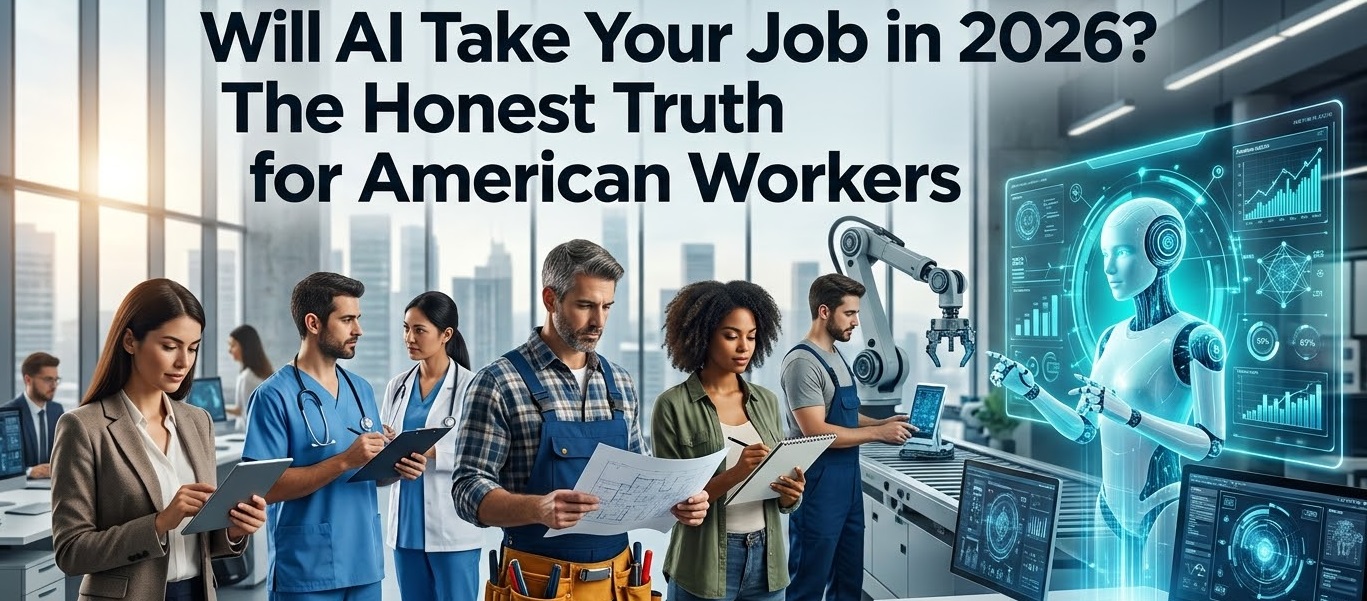
Will AI Take Your Job in 2026-27? The Honest Truth for American Workers
Published: June 2026 | Reading Time: 14 Minutes | Category: Career & Digital Skills | For: All Working Americans — USA
In March 2026 alone, AI led every other cause of corporate layoffs in America, accounting for 15,341 announced job cuts — a quarter of all layoffs that month. Between January and June 2025, American companies reported nearly 78,000 tech job cuts directly connected to AI adoption — hundreds of people losing their jobs every single day. This is not a future hypothetical anymore. It is a 2026 reality already reshaping paychecks in Seattle, Austin, Chicago, Charlotte, and San Jose.
But here is what most headlines leave out: the data is far more specific, and far more nuanced, than the blanket fear “AI will take all our jobs” suggests. Research from the IMF shows 40% of jobs globally face meaningful AI exposure, rising to 60% in advanced economies like the United States. Yet “exposure” does not mean elimination — McKinsey’s research found that while today’s AI technology could theoretically automate 57% of current US work hours, that is fundamentally different from 57% of jobs disappearing. The honest truth sits between the two extremes dominating the public conversation: not “nothing will change” and not “everyone will lose their job” — but something far more specific, occupation by occupation, that every American worker deserves to understand clearly.
This guide breaks down exactly which jobs face real risk, which are growing, who is being affected most right now, and — most importantly — what concrete, achievable steps workers in every industry across Houston, Phoenix, Columbus, Tampa, and Denver can take starting today to protect and grow their careers through this transition.
📋 What This Guide Covers
- Section 1 — The Real Numbers: How Many American Jobs Are Actually at Risk
- Section 2 — The Jobs Facing the Highest Risk Right Now
- Section 3 — The Jobs That Are Actually Growing Because of AI
- Section 4 — Why the “Net Job Growth” Statistic Is Misleading
- Section 5 — Who Is Being Hit Hardest: The Uncomfortable Demographics
- Section 6 — Industry-by-Industry Risk Breakdown
- Section 7 — The 5 Skills That Make You “AI-Resistant”
- Section 8 — Your Career Protection Action Plan by Risk Level
- Section 9 — Building a Backup Income Stream Before You Need One
- Section 10 — Real Stories from Real American Workers
- Section 11 — Free USA Resources for Reskilling and Career Transition
- Section 12 — Your Personal AI-Readiness Checklist
- FAQ — Your Most Honest Questions Answered
Section 1 — The Real Numbers: How Many American Jobs Are Actually at Risk
| AI Job Impact Statistic — USA 2026 | Figure |
|---|---|
| US jobs already replaceable by current AI capability | 11.7% (more than 1 in 10 workers) |
| US workers at risk of automation displacement over next decade | 47% |
| US jobs with at least 50% of tasks already automated | 15.1% (~23.2 million jobs) |
| Jobs globally facing meaningful AI exposure (IMF) | 40% (60% in advanced economies) |
| Current US work hours theoretically automatable today | 57% (McKinsey, hours ≠ jobs eliminated) |
| US workers who say they’ve already lost a job to AI/automation | 13.7% |
| Employers expecting to reduce workforce via AI automation | 40% |
| Business leaders planning to replace workers with AI by end of 2026 | 37% |
| Jobs at least half-automated nationally (jobs now) | 31.1 Million |
| New AI-driven roles globally created by 2030 (offsetting figure) | 97–170 Million |
| North America’s AI adoption rate (highest globally) | ~70% |
Notice the wide range across these credible sources — from 11.7% already replaceable to 47% at risk “over the next decade.” This range itself is the most honest answer: AI’s job impact is not a single number, but a spectrum that depends enormously on your specific occupation, your specific tasks within that occupation, and how quickly your employer chooses to deploy available technology.

Section 2 — The Jobs Facing the Highest Risk Right Now
| Occupation | Automation Risk | Americans Affected | Why |
|---|---|---|---|
| Data entry / clerical workers | 95% | 6.1 million at high risk | AI scans/processes documents far faster with fewer errors |
| Customer service / call centers | Up to 80% | Millions in tier-1 support | AI chatbots and voice agents handle routine inquiries effectively |
| Retail cashiers | 60–65% | Widespread across retail | Self-checkout and computer-vision systems expanding rapidly |
| Bank tellers | 60–65% | Declining steadily | Digital payments and AI-powered banking interfaces |
| Basic content writers/editors | High and rising | Significant displacement already occurring | Generative AI produces routine text rapidly and cheaply |
| Bookkeepers (basic transactional) | Moderate-High | Significant portion of role automatable | AI handles categorization, reconciliation, basic reporting |
| Paralegals (document review) | Moderate-High | Document review tasks specifically | AI rapidly reviews and flags relevant case documents |
Data entry and clerical roles stand out starkly: 7.5 million data-entry and administrative jobs could be lost by 2027 according to research cited in multiple 2026 industry reports — making this the single most exposed occupational category in the entire American workforce right now.
Section 3 — The Jobs That Are Actually Growing Because of AI
The same technology eliminating certain roles is simultaneously creating new demand elsewhere — though, critically, not always for the same workers or in the same locations.
| Growing Role/Field | Why Demand Is Rising | Typical Education Path |
|---|---|---|
| AI prompt engineering / AI operations | Companies need people who can effectively direct and manage AI tools | Certificate or self-taught + portfolio |
| Data science and analytics | AI systems require human oversight, interpretation, validation | Bachelor’s degree typical, bootcamps growing |
| Cybersecurity | More AI systems and data create more attack surfaces to protect | Certifications (CompTIA, CISSP) + experience |
| AI ethics, governance, and compliance | Regulatory and risk requirements growing alongside adoption | Specialized certifications, often legal/compliance background |
| Human-AI collaboration roles | Customer-facing roles requiring empathy AI cannot replicate | Varies widely by industry |
| Skilled trades (electricians, plumbers, HVAC) | Physical, hands-on work remains largely outside AI’s current capability | Trade school, apprenticeship |
| Healthcare direct care roles | Physical patient care and human judgment remain essential | Nursing degree, certifications |
Section 4 — Why the “Net Job Growth” Statistic Is Misleading
The most commonly cited reassuring statistic — that AI will create 97 to 170 million new jobs globally by 2030, more than offsetting the 85-92 million jobs displaced — is technically accurate but dangerously incomplete as comfort for any individual worker.
Here is the problem hidden inside that net-positive number: roughly 77% of emerging AI-related roles require a master’s degree or equivalent advanced experience. Job creation concentrates heavily in technology, data science, AI operations, cybersecurity, and high-skill professional services — fields that are simply inaccessible, in any realistic timeframe, to a 52-year-old data entry clerk in Toledo, Ohio or a call center worker in El Paso, Texas without years of retraining most displaced workers cannot afford to pursue while also paying rent.
This is the honest core of the issue: net positive job creation does not equal smooth individual worker transitions. The new jobs exist. They are simply not accessible to most of the specific people losing their current jobs, at least not without substantial, costly, and time-consuming reskilling — which is precisely why this guide exists.
Section 5 — Who Is Being Hit Hardest: The Uncomfortable Demographics
One of the most significant and least-discussed findings in current labor market research involves exactly who occupies the highest-risk roles in the American economy right now.
| Demographic Finding | Figure |
|---|---|
| Employed US women in high-automation-risk jobs | 79% |
| Employed US men in high-automation-risk jobs | 58% |
| Workers in highest-risk administrative/clerical roles who are female | 86% |
| Clerical/admin workers with lowest “adaptive capacity” to reskill | 6.1 million identified by Brookings |
This concentration reflects decades of labor market history: clerical, administrative, and customer service roles — exactly the categories AI is automating most aggressively right now — have historically been disproportionately staffed by women, particularly women without four-year college degrees. This means the AI transition, while affecting Americans broadly, is landing with disproportionate force on a specific, identifiable segment of the workforce — a reality every affected worker deserves to understand clearly rather than have obscured by reassuring aggregate statistics.

Section 6 — Industry-by-Industry Risk Breakdown
| Industry | Risk Level | Timeline | What’s Most at Risk Within It |
|---|---|---|---|
| Retail | 🔴 High | Now–2028 | Cashiers, basic inventory roles |
| Banking/Finance (consumer-facing) | 🔴 High | Now–2028 | Tellers, basic loan processing, data entry |
| Customer Service/Call Centers | 🔴 High | Now–2027 | Tier-1 support, basic inquiry handling |
| Administrative/Office Support | 🔴 High | Now–2027 | Data entry, scheduling, basic document processing |
| Manufacturing | 🟠 Moderate-High | 2026–2030 | Repetitive assembly, quality inspection roles |
| Legal Services | 🟠 Moderate | 2026–2030 | Document review, basic research (not advocacy/strategy) |
| Healthcare (administrative) | 🟠 Moderate | 2026–2030 | Scheduling, billing, basic coding (not direct patient care) |
| Skilled Trades | 🟢 Low | 2030+ | Physical, on-site work remains largely protected for now |
| Healthcare (direct patient care) | 🟢 Low | 2030+ | Nursing, therapy, hands-on care largely protected |
| Creative/Strategic Leadership | 🟢 Low-Moderate | Varies widely | High-level strategy, complex creative judgment more resistant |
Section 7 — The 5 Skills That Make You “AI-Resistant”
Across every credible labor market study, the same categories of skill consistently appear as the strongest protection against AI displacement — not because they are impossible to automate eventually, but because they remain genuinely difficult, expensive, or undesirable to automate in the near term.
- Complex human judgment under ambiguity. Situations with no clear “correct” answer, requiring weighing competing values or incomplete information, remain a meaningful AI weakness — relevant to management, negotiation, complex client relationships, and crisis response.
- Physical dexterity in unstructured environments. A plumber working in a unique, irregular crawlspace or an electrician troubleshooting a decades-old wiring system faces variability that current robotics cannot reliably handle — a major reason skilled trades remain comparatively protected.
- Genuine emotional connection and trust-building. Healthcare, counseling, sales of complex/high-trust products, and education all rely on human connection that, even when AI can technically perform the informational task, customers and patients consistently prefer from a person.
- Cross-domain creative synthesis. Combining insights from genuinely different fields — strategy, design, business, culture — in novel ways remains a distinctly human strength, even as AI becomes proficient within narrower, well-defined domains.
- AI fluency itself. Somewhat paradoxically, workers who become skilled at directing, evaluating, and integrating AI tools into their own work are consistently the most protected — they become more valuable specifically because they amplify what AI can do rather than competing directly against it.
Section 8 — Your Career Protection Action Plan by Risk Level
| If Your Job Is… | Recommended Action | Timeline |
|---|---|---|
| High Risk (data entry, basic customer service, cashier) | Begin active reskilling NOW toward adjacent higher-skill roles; build a side income stream as a buffer | Start within 30 days |
| Moderate Risk (admin, basic bookkeeping, paralegal) | Develop AI-fluency skills specifically — become the person who directs AI tools rather than competes with them | Start within 90 days |
| Lower Risk (skilled trades, direct healthcare, strategic roles) | Stay informed but prioritize deepening expertise over urgent career pivots | Ongoing monitoring |
| Any Risk Level | Build a financial cushion and at least one income stream independent of your primary employer | Begin immediately, regardless of risk level |
Section 9 — Building a Backup Income Stream Before You Need One
The single most practical, immediately actionable protection against AI-related job loss is not waiting for a layoff to begin building alternative income — it is starting now, while still employed, when the financial pressure to succeed quickly is lowest.
- Freelance work in your existing expertise. A bookkeeper facing automation risk can begin offering specialized advisory bookkeeping services (not just data entry) on Upwork or directly to small businesses, building a client base before any potential layoff.
- Digital skills with growing demand. Virtual assistant work, social media management, and basic AI-tool-assisted content creation can be learned within weeks and provide both immediate supplemental income and a transition path if a primary job is lost.
- Certifications in adjacent growing fields. A customer service worker can pursue a cybersecurity fundamentals certification or data analytics bootcamp during evenings, positioning for a lateral move before displacement forces a rushed, financially desperate transition.
- Building genuine AI fluency in your current role. Becoming visibly skilled at using AI tools to enhance your current job’s output — rather than waiting to be replaced by them — frequently transforms a worker from “at risk of replacement” to “the person managing the AI transition” within their own department.

Section 10 — Real Stories from Real American Workers
Denise, 48 — Former Data Entry Specialist, Toledo, Ohio
After fourteen years in data entry for a regional insurance company, Denise watched her department shrink from twelve people to three over eighteen months as AI document processing tools were deployed. Rather than waiting for her own layoff, she began a free Google Data Analytics certificate program during evenings, six months before her position was eliminated. When the layoff came, she had already completed the certification and built a small portfolio of practice projects. She transitioned into an entry-level data analyst role at a different company within four months — a difficult but navigable transition specifically because she started preparing before the crisis hit. Her reflection: “I saw the writing on the wall a year before it happened. The hardest part wasn’t learning new skills — it was admitting to myself that waiting wasn’t a strategy.”
Marcus, 35 — Customer Service Representative, El Paso, Texas
Marcus worked tier-1 phone support for a telecommunications company as AI chatbots increasingly handled routine calls, reducing his team’s call volume and, eventually, headcount. Anticipating this trend, he spent nights and weekends building a virtual assistant side business, initially earning $400/month helping small business owners with scheduling and email management. By the time his position was eliminated, his side business had grown to $2,200/month, providing crucial financial bridge income while he searched for his next role. He has since grown the virtual assistant business into his primary income source, now earning more independently than his previous call center salary. His advice: “I didn’t see it as a side hustle. I saw it as insurance I was building before I needed the payout.”
Patricia, 56 — Bank Teller, Sacramento, California
After twenty-two years as a bank teller, Patricia faced declining hours as her branch reduced staff in response to increased digital banking adoption. Rather than pursuing an entirely new field, she leveraged her deep customer relationship skills and financial literacy into a role as a financial wellness coach, working with a fintech startup specifically to help customers navigate digital banking tools — a role that combines her existing human-relationship strengths with the technology that had displaced her previous position. Her transition took eleven months and required a temporary pay reduction, but she describes the new role as more secure long-term. Her reflection: “The bank didn’t need someone to count cash anymore. It still desperately needed someone who could explain things to confused, frustrated customers with patience. That’s the skill I had all along.”
Section 11 — Free USA Resources for Reskilling and Career Transition
| Resource | Website | What It Offers |
|---|---|---|
| CareerOneStop (US Dept of Labor) | careeronestop.org | Free career assessment, local training programs, job search tools |
| American Job Centers | careeronestop.org/localhelp | In-person career counseling and training nationwide, free of charge |
| Google Career Certificates | grow.google/certificates | Data analytics, IT support, project management — financial aid available |
| Coursera (free audit option) | coursera.org | University-level courses across every reskilling category |
| Workforce Innovation and Opportunity Act (WIOA) | dol.gov/agencies/eta/wioa | Federal funding for eligible workers’ retraining programs |
| SCORE.org | score.org | Free mentorship for starting a side business or freelance practice |
| Local community college workforce programs | Search “[your city] community college workforce development” | Low-cost certifications in high-demand local fields |
Section 12 — Your Personal AI-Readiness Checklist
| Action | Done? | Priority |
|---|---|---|
| Honestly assess your occupation’s automation risk level | ☐ | 🔴 Critical |
| Build basic AI tool fluency relevant to your field | ☐ | 🔴 Critical |
| Start a small side income stream, even before any job risk materializes | ☐ | 🔴 Critical |
| Research one specific reskilling certification relevant to your situation | ☐ | 🟠 High |
| Build or strengthen a 3-6 month emergency fund | ☐ | 🟠 High |
| Update your resume/LinkedIn highlighting human-skill strengths | ☐ | 🟡 Medium |
| Connect with your local American Job Center or CareerOneStop | ☐ | 🟡 Medium |
| Identify one adjacent role within your industry that is lower-risk | ☐ | 🟡 Medium |
❓ Frequently Asked Questions
Q: Is AI really going to take most American jobs?
The honest answer is more nuanced than yes or no. Current data shows 11.7% of US jobs are already technically replaceable by existing AI, while 47% face displacement risk over the next decade — but “facing risk” does not mean certain elimination. AI exposure varies enormously by specific occupation and even by specific tasks within occupations; data entry and basic customer service face very high risk, while skilled trades and direct patient care remain comparatively protected for the foreseeable future.
Q: How do I know if my specific job is at high risk?
Generally, jobs involving repetitive, rules-based, digitally-mediated tasks face the highest risk — data entry, basic customer service, routine document review, and cashier work top current risk rankings. Jobs requiring physical dexterity in unpredictable environments, deep emotional trust-building, or complex judgment under ambiguity remain comparatively protected. If significant portions of your daily tasks could be described as “look at information, then enter or transfer it elsewhere,” your role likely carries meaningful automation exposure.
Q: If AI creates more jobs than it eliminates, why should I worry?
The net positive job creation statistic, while accurate at a macro level, obscures a critical detail: roughly 77% of emerging AI-related roles require a master’s degree or equivalent advanced experience, and new job creation concentrates heavily in technology and high-skill professional fields. This means net positive job growth does not translate into smooth transitions for most individually displaced workers, particularly those without the time, money, or existing educational background to pursue advanced retraining quickly.
Q: I’m over 50 and worried my job is at risk. Is it too late to reskill?
No — the real stories in this guide specifically include workers in their late 40s and 50s who successfully transitioned by starting preparation before a layoff occurred, rather than waiting until after. Age is less predictive of successful transition than timing: workers who begin reskilling or building alternative income streams while still employed consistently report smoother transitions than those who wait until after a layoff to begin.
Q: What is the single most important thing I can do right now?
Start a small income stream independent of your primary job, even if modest, before you need it. This single action — beginning while still employed rather than waiting for a crisis — appears repeatedly as the defining difference between workers who navigate AI-related job transitions successfully and those who experience prolonged financial hardship after a layoff.
Q: Are some US states or regions more affected than others?
Regions with large administrative, clerical, or manufacturing workforces and fewer alternative employment options tend to face the most concentrated impact, since these are precisely the job categories facing the highest automation exposure. North America overall has the highest AI adoption rate globally at approximately 70%, meaning American workers across virtually every region and industry are experiencing this transition faster than their counterparts in most other parts of the world.
Q: Should I be worried even if my current job seems safe right now?
A degree of proactive preparation is reasonable for nearly every worker, given how rapidly AI capability and adoption have expanded even within the past 12-18 months. Building basic AI fluency, maintaining an emergency fund, and developing at least general awareness of reskilling resources costs little and provides meaningful protection even for workers in currently lower-risk roles, since the pace of change has consistently outstripped most projections made just a year or two earlier.
Final Thought
The honest truth about AI and American jobs in 2026 sits uncomfortably between the two loudest narratives. It is not true that nothing will change — 23.2 million American jobs already have at least half their tasks automated, and the pace is accelerating. It is also not true that every job is doomed — physical trades, direct healthcare, and roles built on genuine human trust remain meaningfully protected, and AI itself is creating real, if unevenly distributed, new opportunities.
What matters most for any individual American worker in Toledo, El Paso, Sacramento, or anywhere else is not the macro statistic, but an honest, specific assessment of their own occupation’s risk level — followed by deliberate, early action rather than reactive scrambling after a layoff notice arrives. The workers profiled in this guide did not avoid disruption. They simply refused to wait for it before preparing.
Found this guide useful? Share it with someone in your life whose job might be at risk — sometimes an honest, specific conversation about real risk is more valuable than either blind reassurance or blind panic.