
YouTuber Life Before and After Success in India Real Journeys of 6 Creators
📅 Published: November 2026 | ⏱ Reading Time: ~22 Minutes | 🗂 Category: DIGITAL WORLD | 👥 For: Aspiring and small YouTubers in India
Imagine a 22-year-old in Indore uploading his twelfth video at 1 a.m. It gets 41 views. His family thinks he’s wasting evenings, and his phone has barely any storage left. Plenty of Indian creators have stood in exactly that spot, and a handful walked out of it into millions of subscribers and a completely different life.
The timing of this guide matters. From 1 February 2027, new creators will need 8,000 qualified watch hours or 20 million Shorts views to join the YouTube Partner Program, double today’s bar, according to YouTube’s official Partner Program update page. Creators already in the program keep their status. That leaves roughly ten weeks from today, and plenty of beginners are asking whether it’s still worth starting.
This post follows six creators from Jharkhand, Uttar Pradesh, Delhi, Maharashtra and Uttarakhand, from the days before the audience to the life that came after. These are public stories, so every one of them comes with a source. Most money figures are self-reported or media estimates, and we label them that way. If you’ve read Indian YouTubers success stories before, you’ll notice we keep the hype low and the numbers honest.
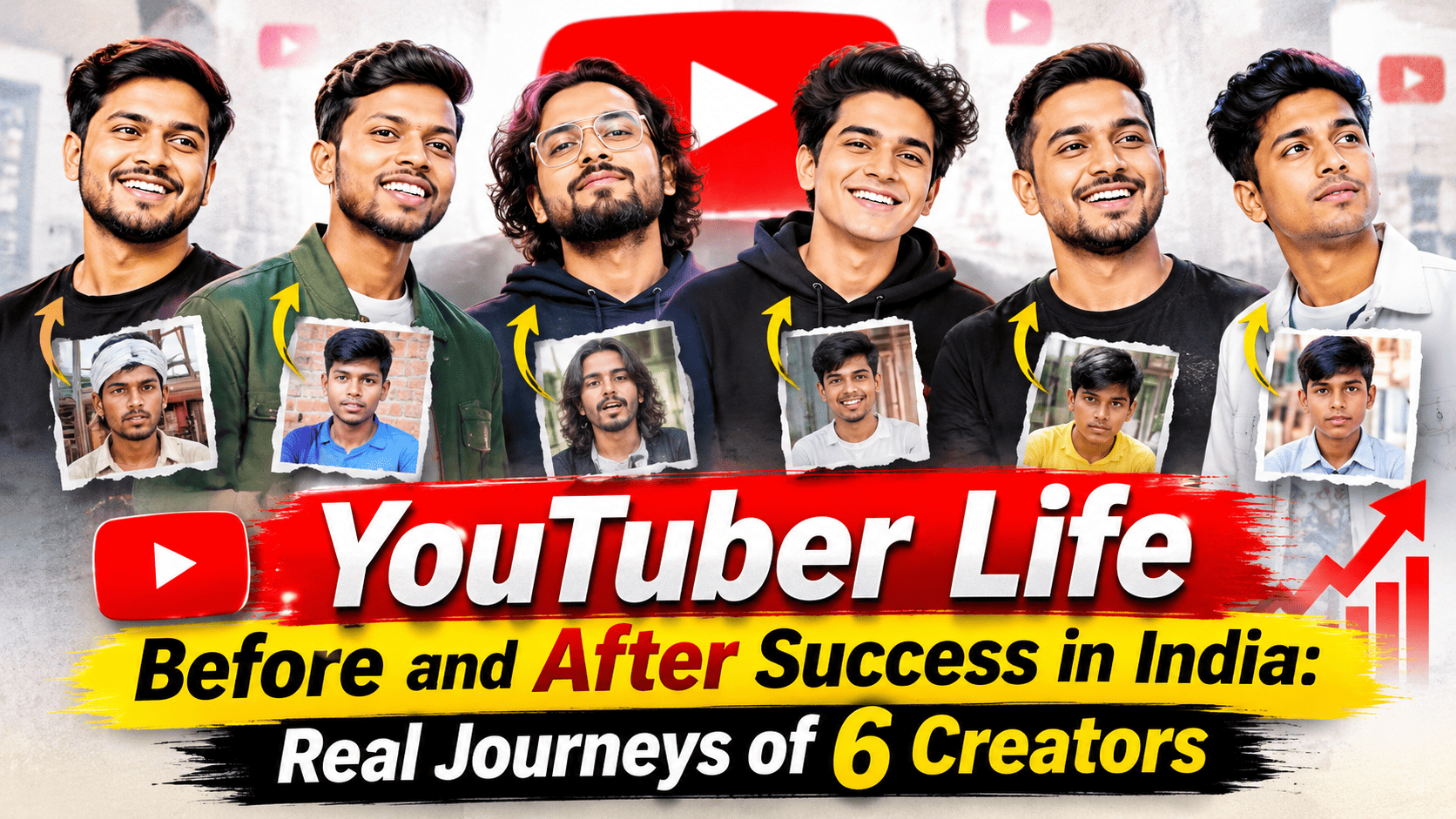
You’ll also get the full YouTube monetization rules for 2026, the 2027 changes, what creators earn in rupees, how tax works, and a practical roadmap from us. If you want a clear picture of YouTuber life before and after success in India, this guide covers the money, the habits and the hard parts.
Let’s get into it.
 Table of Contents
- Life Before Success: Why Ordinary Indians Start on YouTube
- Life After Success: What Really Changes
- 6 Creators at a Glance: Before vs After
- Journey 1: Rajesh Rawani
- Journey 2: Manoj Dey
- Journey 3: Bhuvan Bam
- Journey 4: Ashish Chanchlani
- Journey 5: Amit Bhadana
- Journey 6: Sourav Joshi
- YouTube Monetization Rules 2026 (Until 31 January 2027)
- New YouTube Partner Program Rules From 1 February 2027
- How Much Do YouTubers Earn in India?
 The Golden Path: Our Roadmap to YouTube Success
- What It Costs to Start a Channel in India
- Indian Rules Every Creator Should Know
- Realistic Comparison: What the Numbers Tell You
- Where the Money Comes From on YouTube
- How to Get Started With Zero Experience: Step by Step
- Small Creator Reality: Three Made-Up Examples
- The Hard Side of Fame
- Red Flags and Mistakes to Avoid
- Free and Paid Tools
- Quick Reference Checklist
- Frequently Asked Questions (FAQ)
- Final Thought
Life Before Success: Why Ordinary Indians Start on YouTube
Almost none of the creators in this guide began with a studio, a team or a plan. They began with a phone, a free evening and a feeling that regular work wasn’t going to change much. Rajesh Rawani was driving trucks across states. Manoj Dey grew up in a Jharkhand village where his father repaired bicycles. Bhuvan Bam was a college student singing at a Delhi restaurant.
The setup is familiar across the country. A creator in Jaipur or Lucknow usually has parents worried about money, a tiny budget and no proof that videos can pay rent. Add patchy mobile data and pressure to pick a “safe” degree, and the first months feel lonely. That’s the part most success stories skip.
So why do people still start? Because the entry cost is close to zero and the upside, while rare, is real. Here’s what pulls Indian beginners in.
 Near-zero startup cost: a smartphone and a free editing app are enough for your first upload.
- Big Hindi and regional audiences: viewers look for content in Hindi, Marathi, Gujarati, Tamil, Bengali and more.
- No degree required: nobody asks for a certificate before you press upload.
- You can keep your job: reports say Rawani kept driving while his channel grew.
- Several ways to earn: ads, memberships, Super Chat, Shopping and brand deals.
- Small towns work: Jamtara, Bulandshahr and Haldwani aren’t metros, and that didn’t stop anyone here.
- Your real life is the content: a truck cabin kitchen became a channel.
| Feature | Long-form videos | Shorts | Live streams |
|---|---|---|---|
| Cost to start | ₹0 with a phone | ₹0 with a phone | ₹0 with a phone |
| Counts toward watch hours? | Yes, public videos |
 No, Shorts have their own views path |
Archived public streams |
| Ad earnings per 1,000 views in India (estimate) | ₹50 to ₹200 | ₹5 to ₹30 | Varies, plus Super Chat |
| Effort per upload | Higher |
Lower |
Higher |
| Best for | Steady income | Fast discovery | Loyal community |


Life After Success: What Really Changes
Money changes first, but not evenly. Rawani reportedly moved from a driver’s salary to a new home. Dey went from a Celerio X to a Mercedes SUV over six years. Those are big jumps, and they came after years of uploading, not weeks.
Then the quieter changes show up. Strangers recognize you. Brands email you. Your family starts treating the channel as a real business, and you start treating it like one too. Taxes, invoices and contracts arrive earlier than most people expect.
Not all of it is comfortable. Success brings pressure to keep posting, public opinions on everything you do, and income that moves with views. Here’s what tends to shift.
- Income: it can rise sharply, but it swings with views and seasons.
- Time: shooting, editing and replying never really stop.
- Privacy: your face, family and daily routine become public property.
- Opportunities: series, music, brand deals and films open up for the biggest names.
- Responsibility: sponsored posts must be disclosed, and tax must be filed.
YouTuber Life Before and After Success in India: 6 Creators at a Glance
Here’s the short version before we go deep. Only Rawani has publicly shared actual income numbers, and those are self-reported. For everyone else, we stick to milestones that were reported by news outlets and profiles. Subscriber counts change daily, so check each channel page for the live number.
| Creator | Before YouTube | After success | Source type |
|---|---|---|---|
| Rajesh Rawani | Truck driver for 20+ years, earning ₹25,000 to ₹30,000 a month | Reported ₹4 to 5 lakh a month, new home | Self-reported, Business Today and others |
| Manoj Dey | Modest village life in Jharkhand, father repaired bicycles | Celerio X (2019), Harrier (2021), Mercedes GLC (2025) | Cartoq |
| Bhuvan Bam | College student singing at a Delhi restaurant | First Indian YouTuber to cross 10 million subscribers (2018) | The Quint, IWMBuzz |
| Ashish Chanchlani | Engineering student whose parents worried about film careers | Diamond Play Button, full-time creator | StartupTalky, Business Insider India |
| Amit Bhadana | Delhi University law student, lost his father at five (as per profiles) | First individual Indian creator to reach 20 million subscribers (2020) | Wikipedia, Republic World |
| Sourav Joshi | Art channel with 3,000 to 4,000 subscribers, AdSense verification trouble | One of India’s biggest vlogging channels | Zee News, creator profiles |
Journey 1: Rajesh Rawani, the Truck Driver Who Cooked on the Highway
Rawani comes from Jamtara in Jharkhand and has spent around 25 years driving heavy vehicles across India. On long trips he cooked chicken, mutton, fish and paneer by the roadside and sent short clips to his family. According to Business Today’s September 2026 profile, his son Sagar began editing and uploading the footage to YouTube in 2021.
The channel, R Rajesh Vlogs, grew as viewers got curious about the man behind the videos. A face-reveal video reportedly drew about 4.5 lakh views in 24 hours. Earlier media reports put the channel near 1.86 million subscribers in August 2024.
His story shows how a daily routine can become content. He didn’t invent a new format. He filmed what he already did, in a place few viewers had ever seen.
🔗 Follow Rajesh Rawani: R Rajesh Vlogs on YouTube
What Do the Numbers Say?
| Item | Before | After | Note |
|---|---|---|---|
| Monthly income | ₹25,000 to ₹30,000 (driving) | ₹4 to 5 lakh from YouTube, best months reported between ₹10 lakh and ₹18 lakh | Self-reported, not audited |
| Home | Family depended on his father’s driving income | New home built | Reported by media |
| Channel size | No channel | About 1.86 million subscribers | As of August 2024 reports |
What you can take from this journey:
- Film something you already do every day.
- Let family help with editing and uploads.
- Expect income to swing from month to month.
- Treat the biggest figures as best-case, not typical.
Journey 2: Manoj Dey, From a Village Home to a Mercedes
Dey is from Jharkhand. His father repaired bicycles in the village, and he studied in an ordinary government school. Cartoq’s profile of Manoj Dey describes the early years as financially hard and even says he once lived in a hut.
Once money started coming in, he upgraded his equipment and studio. Today he reportedly runs multiple channels. The same profile traces his cars: a Maruti Celerio X in 2019, a Tata Harrier Dark edition in 2021, and a Mercedes GLC 300, priced around ₹80 lakh ex-showroom, in 2025. He took delivery from a Delhi dealer.
The profile counted about 7.2 million YouTube subscribers in August 2025. It also estimates his income at around ₹10 lakh a month, but that’s the publication’s estimate, not a figure he has confirmed.
🔗 Follow Manoj Dey: Manoj Dey on YouTube | Manoj Dey Vlogs on YouTube | Instagram
How Fast Did the Lifestyle Change?
| Year | Milestone | Note |
|---|---|---|
| 2019 | Maruti Celerio X | Early car, reported by Cartoq |
| 2021 | Tata Harrier Dark edition | Upgrade as channel grew |
| 2025 | Mercedes GLC 300 (about ₹80 lakh ex-showroom) | Delivered in Delhi |
| Aug 2025 | About 7.2 million subscribers | Income of ₹10 lakh a month is an estimate |
What you can take from this journey:
- Spend early earnings on equipment before luxuries.
- Build more than one channel once the first one works.
- Six years from the first car to the Mercedes is a realistic timeline.
Journey 3: Bhuvan Bam, the Restaurant Singer Who Became a Pioneer
Bam grew up in Delhi and sang at a Mughlai restaurant while he was in college. His parents weren’t comfortable with the singing, which he has said in interviews. He started BB Ki Vines in 2015, short comedy skits shot on a phone where he played every character himself.
In 2018 he became the first Indian YouTube creator to cross 10 million subscribers. By 2021 the channel had passed 24 million, and Social Blade data cited by AltBollywood put it near 26.5 million in September 2026. Not everything was celebration. In 2021, during the second COVID wave, Bam lost both his parents within a month, and later said work helped him cope.
He released his series Dhindora on the channel on 14 October 2021 and has since moved into other series and music. The takeaway isn’t that comedy works. It’s that an early start plus a distinctive voice gave him room to grow into new formats.
🔗 Follow Bhuvan Bam: BB Ki Vines on YouTube | Instagram
What Changed Besides the Subscriber Count?
| Milestone | When | Note |
|---|---|---|
| Launched BB Ki Vines | 2015 | Phone-shot skits |
| First Indian creator past 10 million subscribers | 2018 | Reported by The Quint |
| Dhindora web series on his channel | October 2021 | Move into longer storytelling |
| About 26.5 million subscribers | September 2026 | Social Blade, as cited by AltBollywood |
What you can take from this journey:
- Original characters travel further than copies of trends.
- Start early in a format, and be patient with your growth.
- Keep working through hard personal seasons only if you truly can.
- Plan your next format before the first one fades.
Journey 4: Ashish Chanchlani, Vines to Diamond Play Button
Chanchlani was born in Ulhasnagar, Maharashtra. According to StartupTalky, his parents owned a multiplex, so he grew up watching new films every week and wanted to act. His parents, like many Indian parents, worried that film is an insecure career, and he went for an engineering degree.
He discovered Vine in 2014 and uploaded his first comedy vine that year. He later moved to YouTube, and his sketches about family, college and daily Indian life took off. He crossed 10 million subscribers and reportedly became the fourth Indian creator to receive the Diamond Play Button.
By February 2021, Business Insider India described him as the second-most subscribed individual YouTuber in the country, with over 23 million subscribers. Reports since then put the channel anywhere from 30 to 35 million, so check the live count.
🔗 Follow Ashish Chanchlani: Ashish Chanchlani Vines on YouTube | Instagram
How Did the Career Shift Happen?
| Stage | What happened | Source type |
|---|---|---|
| Before | Engineering student, acting dream on hold | StartupTalky |
| 2014 | First comedy vine | YourStory |
| Feb 2021 | Over 23 million subscribers, second-most subscribed individual creator | Business Insider India |
| 2025 to 2026 | Roughly 30 to 35 million subscribers (reports vary) | Various ranking lists |
What you can take from this journey:
- Use the format available today, even if it later disappears.
- Relatable family situations travel across Indian cities.
- You can study first and create on the side.
Journey 5: Amit Bhadana, Law Student to 20 Million Subscribers
Bhadana was born in Bulandshahr, Uttar Pradesh, and moved to Delhi as a child. Creator profiles say he lost his father at the age of five and later studied law at Delhi University. He had been dubbing clips and posting on Facebook before he began publishing full YouTube videos on 1 March 2017.
Growth came fast after that. One of his videos was featured on YouTube’s 2018 global top 10 videos list. In May 2020, he said his channel had passed 20 million subscribers, making him the first individual Indian creator to reach that mark, as reported by Republic World. A May 2023 update put the count at 24.4 million.
His hometown flavor, Haryanvi and Delhi characters and school-life situations, is the reason people remember him. In 2021 he released the song Father Saab, dedicated to his father’s memory.
🔗 Follow Amit Bhadana: Amit Bhadana on YouTube | Instagram
What Does His Timeline Look Like?
| When | Milestone | Source type |
|---|---|---|
| March 2017 | Began publishing full videos | Wikipedia |
| 2018 | A video on YouTube’s global top 10 list | Wikipedia |
| May 2020 | 20 million subscribers, first individual Indian creator | Republic World, Wikipedia |
| May 2023 | 24.4 million subscribers | Wikipedia |
What you can take from this journey:
- Local language and local humor build a loyal base.
- A professional degree gives you a safety net while you test the channel.
- Three years from first full video to 20 million is the exception, not the plan.
Journey 6: Sourav Joshi, the Vlogger Who Almost Quit Over Verification
Joshi was born in Dehradun, Uttarakhand, and his family later settled in Haldwani. He started on YouTube with pencil-art videos, uploading his first on 24 July 2017. After 250 to 300 videos, Zee News reports, the art channel had only 3,000 to 4,000 subscribers.
He then tried vlogging. Creator profiles say his first vlogging channels ran into trouble with AdSense identity verification, and one profile puts the first one at 30,000 subscribers before he left it. His third attempt, Sourav Joshi Vlogs, started on 19 February 2019 and the verification went through.
The turning point, according to the same profile, was a 100 vlogs in 100 days challenge, followed by a 365-day daily vlog run. Family-friendly, clean content did the rest. Subscriber figures vary by source, from about 30 million to over 40 million, so check the channel page.
🔗 Follow Sourav Joshi: Sourav Joshi Vlogs on YouTube | Instagram
What Held Him Back, and What Fixed It?
| Problem | What he did | Lesson |
|---|---|---|
| Slow growth on art videos | Tried vlogging | Test formats instead of waiting |
| AdSense identity verification | Started a fresh channel and got verified | Sort out your documents early |
| Low daily views | 100 vlogs in 100 days | Consistency builds viewing habits |
What you can take from this journey:
- Keep your name, address, PAN and bank details consistent from day one.
- A failed channel can teach you the next format.
- Daily posting worked for him, but it needs energy you can sustain.
YouTube Monetization Rules 2026 for Indian Creators (Until 31 January 2027)
Until 31 January 2027, the existing rules apply. For full ad monetization you need 1,000 subscribers plus either 4,000 valid public watch hours in the last 12 months or 10 million valid public Shorts views in the last 90 days, as listed on YouTube’s Partner Programme overview and eligibility page. You also need no active Community Guidelines strike and 2-Step Verification turned on.
Several guides and Indian business media report that India is on YouTube’s expanded program list, which opens fan funding at a lower level. Check the Earn tab in YouTube Studio to see exactly what applies to your channel.
| Requirement | Full monetization (ads) | Early tier (fan funding) |
|---|---|---|
| Subscribers | 1,000 | 500 |
| Public watch hours (365 days) | 4,000 | 3,000 |
| OR Shorts views (90 days) | 10 million | 3 million |
| Public uploads | Not required | 3 in the last 90 days |
| What you can earn | Ads, Premium share, Shorts pool, fan funding | Memberships, Super Chat, Super Thanks, Shopping |
Only public videos count. If you set a video to private or unlisted, or delete it, its watch time stops counting. Watch hours from Shorts feed views don’t count toward the 4,000 hours, and views from paid ad campaigns don’t count either. Meeting the numbers only makes you eligible to apply, because YouTube still reviews the channel.
New YouTube Partner Program Rules From 1 February 2027
This is the biggest change to the program since 2018. From 1 February 2027, new applicants need 1,000 subscribers plus 8,000 qualified watch hours in the last 365 days or 20 million qualified Shorts views in the last 90 days. If you’re already in the program, YouTube says your status isn’t affected by the entry change.
The numbers look abstract, so here’s the daily math. 8,000 hours is about 22 hours of watch time every day for a year. 20 million Shorts views in 90 days is roughly 2,22,222 views every day. The Shorts earnings floor, 10 million views in 90 days, works out to about 1,11,111 views a day.
| Item | Until 31 Jan 2027 | From 1 Feb 2027 |
|---|---|---|
| Watch hours for new applicants | 4,000 (12 months) | 8,000 (365 days) |
| Shorts views for new applicants | 10 million (90 days) | 20 million (90 days) |
| Subscribers | 1,000 | 1,000 (unchanged) |
| Fan funding and Shopping tier | 500 subs + 3,000 hours or 3M Shorts views | No change |
| Earning from the Shorts Creator Pool | No rolling floor | 10M Shorts views in the last 90 days, checked monthly |
| Channel counts as active if | Older activity rules | 1,000 watch hours in 365 days, or 1M Shorts views in 90 days, or 2 long videos or 5 Shorts every 90 days |
Three details trip people up. First, missing the Shorts floor doesn’t remove you from the program and doesn’t touch your long-form earnings. Second, existing partners must accept the updated terms in YouTube Studio by 31 January 2027, or they stop earning from the related features from 1 February until they accept. They don’t lose their partner status. Third, YouTube is also expanding Premium Lite, with creators sharing a pool of 60% of net subscription revenue, and Premium views share a pool of 30%.
Some third-party sites describe the Shorts floor as unchanged. YouTube’s own help page lists it as a new requirement from 1 February 2027, so confirm on that page before you act.
How Much Do YouTubers Earn in India?
There’s no fixed rate. Earnings depend on niche, audience country, video length and season. Published guides quote YouTube earnings per 1,000 views in India (RPM) anywhere from ₹25 to ₹200 for long videos and ₹5 to ₹30 for Shorts. One estimate from upGrowth for September 2026 puts typical Indian creators at ₹25 to ₹150 per 1,000 views. Treat every figure here as an estimate.
Creators generally receive about 55% of ad revenue on long-form watch pages, and finance, tech and education niches tend to pay more than comedy or vlogs. Audience location matters too, since viewers in richer markets bring higher ad rates.
| Monthly views | Long-form at ₹50 to ₹150 per 1,000 (estimate) | Shorts at ₹5 to ₹30 per 1,000 (estimate) |
|---|---|---|
| 10,000 | ₹500 to ₹1,500 | ₹50 to ₹300 |
| 1,00,000 | ₹5,000 to ₹15,000 | ₹500 to ₹3,000 |
| 10,00,000 | ₹50,000 to ₹1,50,000 | ₹5,000 to ₹30,000 |
| 1 crore (10 million) | ₹5,00,000 to ₹15,00,000 | ₹50,000 to ₹3,00,000 |
See how little 10 million Shorts views can pay? That gap is why creators use Shorts for discovery and long videos for income.
How Does YouTube Income Tax in India Work?
There are two layers. First, Google must collect US tax information from every monetizing creator. Per YouTube’s U.S. tax requirements page, creators outside the US who submit tax info see withholding of 0% to 30% on earnings from US viewers only, and creators who submit nothing can face up to 24% of total worldwide earnings. Indian business media report that the India-US treaty brings the rate on US-viewer earnings down to 15%.
Second, your income is still taxable in India. Many Indian tax guides say AdSense income is treated as an export of services for GST, and that you can claim foreign tax credit using Form 67, but details depend on your case. Keep every statement and invoice, and ask a chartered accountant (CA) to confirm what applies to you.
⭐ The Golden Path: Our Roadmap to YouTube Success in India
This section is our own view, built from the six journeys and the new rules. It isn’t a guarantee. Rawani, Dey, Bam, Chanchlani, Bhadana and Joshi all started in earlier years, and the 2027 bar makes the path harder for new channels. But harder doesn’t mean closed.
Here’s the math behind the plan. If viewers watch an average of 4 minutes per view, 3,000 hours needs about 45,000 views, and 8,000 hours needs about 1,20,000 views. Those are reachable numbers for a focused channel, but only if people actually keep watching.
| Phase | Goal | What to do | Timeline (our estimate) |
|---|---|---|---|
| 1. Pick | One niche, one language, one viewer | Choose a topic you can film at least 100 times without getting bored | Weeks 1 to 2 |
| 2. Prove | Learn what holds attention | Post twice a week for 12 weeks and check retention in YouTube Studio | Months 1 to 3 |
| 3. Reach 500 | Enter the early tier if available to you | Use Shorts to find viewers, one long video weekly to keep them | Months 3 to 8 |
| 4. Build hours | Move toward 8,000 hours | Repeat the 2 or 3 formats that held viewers longest | Months 6 to 14 or longer |
| 5. Get paid properly | Clean setup | Link AdSense, submit tax info, match PAN and bank details, accept new terms | When you qualify |
| 6. Diversify | Reduce dependence on ads | Add memberships, Shopping, disclosed brand deals, or your own product | Year 2 |
Five rules we’d follow:
- Make videos for one specific person, such as a Class 12 student in Patna or a home cook in Surat.
- Win the first 5 seconds. Show the result or the problem right away.
- Never buy subscribers or views. It breaks YouTube’s policies and can cost you the channel.
- Keep your day job until your channel income covers expenses for several months.
- Review analytics weekly, then change one thing at a time.
What It Costs to Start a Channel in India
You can start free. Spending money early rarely fixes weak videos, so buy only what removes a real problem. The ranges below are our estimates for Indian buyers and will vary by city and brand.
| Item | Free option | Paid range (estimate) | Priority |
|---|---|---|---|
| Camera | Your smartphone | ₹0 to ₹60,000 | 🟡 Medium |
| Microphone | Phone mic in a quiet room | ₹500 to ₹5,000 | 🔴 Critical |
| Lighting | Window light | ₹800 to ₹4,000 | 🟠 High |
| Editing software | Free mobile and desktop apps | ₹0 to a few thousand a year | 🟠 High |
| Internet data | Existing plan | ₹300 to ₹800 a month | 🔴 Critical |
| CA help for tax | Not free | Varies, ask for a quote | 🟠 High, once income starts |
Indian Rules Every Creator Should Know
Income tax. Your YouTube income goes into your Indian tax return through the Income Tax Department’s e-filing system. Rules and forms differ by income level, so a CA is worth paying once you earn regularly.
GST. Under the CGST Act, service providers generally need GST registration once turnover crosses ₹20 lakh, or ₹10 lakh in special category states. Many guides say AdSense payments from abroad are zero-rated exports, but you need registration to file a Letter of Undertaking (LUT). Brand deals from Indian companies are a different matter and may attract 18% GST once you’re registered.
Paid promotions. The Department of Consumer Affairs’ endorsement guidelines require influencers to disclose material connections, using words like “ad”, “sponsored” or “paid promotion”, in the same language as the content. Business Standard’s August 2026 explainer notes that under the Consumer Protection Act, 2019, the CCPA can fine an endorser up to ₹10 lakh, up to ₹50 lakh for a repeat offence, and bar an endorser for up to one year, or three years for repeats.
Online abuse and fraud. Report harassment, impersonation or scams on the National Cyber Crime Reporting Portal at cybercrime.gov.in, or call the 1930 helpline for financial fraud.
Realistic Comparison: What the Numbers Tell You
Put the six creators side by side and one thing stands out. The public money data is thin. Most outlets repeat each other, and net-worth lists vary wildly, so we left them out. YouTube has said more than 3 million creators are in the Partner Program worldwide, which tells you these six sit at the very top.
| # | Creator | Niche | Biggest public milestone | Money figure on record |
|---|---|---|---|---|
| 1 | Rajesh Rawani | Roadside cooking | About 1.86M subscribers (Aug 2024) | ₹4 to 5 lakh a month, self-reported |
| 2 | Manoj Dey | Motivation and lifestyle | About 7.2M subscribers (Aug 2025) | Estimated ₹10 lakh a month by Cartoq |
| 3 | Bhuvan Bam | Comedy and music | First Indian creator to 10M (2018) | Not publicly confirmed |
| 4 | Ashish Chanchlani | Comedy sketches | Diamond Play Button | Not publicly confirmed |
| 5 | Amit Bhadana | Comedy | First individual Indian creator to 20M (2020) | Not publicly confirmed |
| 6 | Sourav Joshi | Family vlogs | One of India’s biggest vlog channels | Not publicly confirmed |
Where the Money Comes From on YouTube
Ads are only one stream. Smaller creators often earn their first rupees from fan funding or brand deals, long before ad money becomes meaningful.
| Income source | Best for | How it works | Free to start? |
|---|---|---|---|
| Watch page ads | Long-form channels | Revenue share after you join the Partner Program | ✅ Yes, if you qualify |
| Shorts Creator Pool | High-volume Shorts creators | Share of a pool based on views, with a 10M floor from February 2027 | ✅ Yes, if you qualify |
| Memberships, Super Chat, Super Thanks | Loyal communities | Fans pay you directly through YouTube features | ✅ Yes, early tier |
| YouTube Shopping affiliate | Review and product channels | Tag products and earn commission, India is a listed country | ✅ Yes, rules apply |
| Brand deals | Any channel with a clear audience | Brands pay you for a disclosed promotion | ✅ Yes, but disclosure is mandatory |
| Your own products or courses | Experts and teachers | Sell something you make, using the channel to find buyers | ⭐ Costs time to build |
How to Get Started With Zero Experience: Step by Step
- Pick one topic and one language. Hindi, Gujarati, Tamil or English all work, as long as you stay consistent.
- Write down your viewer. Give them an age, a city and a problem you can solve.
- Create the channel and check your Google account security. Turn on 2-Step Verification now, since you’ll need it later.
- Record your first five videos with your phone. Don’t wait for new equipment.
- Publish on a fixed schedule. Twice a week is enough for the first three months.
- Read the analytics every week. Look at where viewers leave, then fix that part next time.
- Track your thresholds in YouTube Studio’s Earn tab. Apply the moment you qualify, and keep your PAN, name and bank details consistent.
Small Creator Reality: Three Made-Up Examples
These are made-up examples based on common patterns. They are not real people or real results.
Story 1: Kavita, 24 — home baker, Indore, Madhya Pradesh
Kavita posted recipe Shorts for eight months and reached 2,000 subscribers. Her views rarely crossed 3,000. When she added one weekly 10-minute long video, her watch time climbed slowly. After 14 months she was earning about ₹3,000 a month from ads and ₹6,000 from one local brand deal, which she disclosed as an ad.
Story 2: Imran, 29 — electrician, Surat, Gujarat
Imran filmed repair tips in Gujarati after his shift. For a year, he made almost nothing, and his friends joked about it. Then a video on fixing a tripping switch picked up 1.2 lakh views. At an estimated ₹60 per 1,000 views, that single video earned him roughly ₹7,200. It wasn’t life-changing, but it showed him which topic to repeat.
Story 3: Ritu, 21 — college student, Jaipur, Rajasthan
Ritu posted daily Shorts on study tips and hit 20,000 subscribers in six months. Her income was close to zero because Shorts pay so little per view. She started linking each Short to a long video and, after seven more months, crossed 4,000 watch hours. She applied before the rules changed and kept her studies going.
The Hard Side of Fame
Success has a cost, and these six journeys show it. Bhuvan Bam kept creating while grieving both parents. Sourav Joshi lost months to verification problems. Rawani’s income depends on viewership, so lean months follow strong ones.
Online trolling is part of the deal for bigger channels, and so is the loss of a private life. Set boundaries early. Don’t film your home address, your child’s school or your daily routine. If someone threatens, impersonates or harasses you, save screenshots and report it on cybercrime.gov.in.
Money brings its own stress too. A good month tempts people to spend like it will repeat. Keep three to six months of expenses aside before you quit a job, and file your taxes on time.
Red Flags and Mistakes to Avoid
- Buying subscribers or views: it breaks the rules and doesn’t bring watch time.
- Trusting “earn ₹1 lakh a month” courses: check whether the seller shows verifiable channel results.
- Copying other channels’ videos: mass-produced or repetitive content isn’t monetized.
- Deleting or privating old videos: their watch hours stop counting toward the threshold.
- Ignoring tax info in AdSense: up to 24% of total earnings can be withheld if you submit nothing.
- Hiding paid promotions: that can lead to penalties under consumer law.
- Quitting your job after one viral video: one spike isn’t a business.
- Missing the 31 January 2027 deadline: existing partners should accept the new terms in Studio.
Free and Paid Tools
Paid prices change often, so confirm them on each official pricing page before you buy.
| Tool | What it does | Free or paid? | Why you need it |
|---|---|---|---|
| YouTube Studio | Analytics, Earn tab, uploads | Free | Tracks your watch hours and eligibility |
| Google AdSense | Payments and tax info | Free | Needed to get paid after monetization |
| Google Trends | Shows what people search for | Free | Helps you choose topics |
| Mobile video editor | Cuts, captions, music | Free with paid upgrades | Gets your first videos edited cheaply |
| Canva | Thumbnails and graphics | Free plan, paid plans vary | Better thumbnails improve clicks |
| Keyword and SEO extensions | Title and tag ideas | Free tiers, paid plans vary | Helps your videos get found |
| Chartered accountant | Income tax and GST advice | Paid, ask for a quote | Keeps your filings correct |
✅ Quick Reference Checklist: Your Action Plan
| ☐ | Action step | Priority | When to do it |
|---|---|---|---|
| ☐ | Choose one niche and language | 🔴 Critical | Week 1 |
| ☐ | Turn on 2-Step Verification | 🔴 Critical | Before applying |
| ☐ | Publish on a fixed weekly schedule | 🔴 Critical | Every week |
| ☐ | Keep videos public, never delete old ones | 🟠 High | Always |
| ☐ | Track thresholds in the Earn tab | 🟠 High | Monthly |
| ☐ | Match PAN, name and bank details | 🟠 High | Before AdSense setup |
| ☐ | Submit US tax info in AdSense | 🔴 Critical | After monetization |
| ☐ | Accept the new terms (existing partners) | 🔴 Critical | By 31 January 2027 |
| ☐ | Disclose every paid promotion | 🟠 High | Every sponsored post |
| ☐ | Talk to a CA about tax and GST | 🟡 Medium | Once income is regular |
Frequently Asked Questions (FAQ)
1. How many subscribers are needed for YouTube monetization in India?
For full ad monetization you need 1,000 subscribers. You also need 4,000 valid public watch hours in 12 months or 10 million valid public Shorts views in 90 days, until 31 January 2027. From 1 February 2027, new applicants need 8,000 watch hours or 20 million Shorts views instead. Subscribers stay at 1,000. You can check your exact progress in the Earn tab of YouTube Studio.
2. What are 4,000 watch hours?
It means 4,000 hours of total viewing time across your public long-form videos over the last 12 months. Archived public live streams count too. Private, unlisted and deleted videos don’t, and watch time from Shorts feed views doesn’t count toward this number. Views from paid ad campaigns are excluded as well, though organic follow-on views count.
3. What are the YouTube monetization rules for 2027?
From 1 February 2027, new applicants need 1,000 subscribers plus 8,000 qualified watch hours in 365 days or 20 million qualified Shorts views in 90 days. The 500-subscriber fan funding tier doesn’t change. Earning from the Shorts Creator Pool needs 10 million qualified Shorts views in the last 90 days. Existing partners should also accept the updated terms in Studio by 31 January 2027.
4. How long does it take to complete 8,000 watch hours?
It depends entirely on your daily watch time. At 30 hours a day, you’d finish in about 267 days. At 50 hours a day, it takes about 160 days, and at 22 hours a day it takes the full 365. Most new channels gain watch time slowly at first and faster after a few videos take off. Better retention helps more than uploading more often.
5. Will the new rules apply to channels that are already monetized?
The new entry thresholds apply to new applicants only. YouTube says creators already in the Partner Program keep their status. Two things still reach existing partners: the 10 million Shorts views requirement for Shorts Creator Pool earnings, and the updated activity test. You must also accept the new terms by 31 January 2027, or the related earning features stop on 1 February until you accept.
6. Can you earn money on YouTube in India with 500 subscribers?
Possibly, but not from ads. The early tier needs 500 subscribers, 3 public uploads in 90 days, and either 3,000 watch hours or 3 million Shorts views. It opens fan funding such as memberships, Super Chat and Super Thanks, plus Shopping features. Reports say India is on the expanded program list, but check your Earn tab to confirm. Ad revenue sharing still needs 1,000 subscribers.
7. How much income does a channel with 1 lakh subscribers make?
Subscribers alone don’t pay you. Views do. As an estimate, 1 lakh long-form views a month at ₹50 to ₹150 per 1,000 views earns about ₹5,000 to ₹15,000. Brand deals can add more, but they depend on your niche and engagement. Two channels with the same subscriber count can earn very differently.
8. How many views do you need to earn from Shorts?
To join the Partner Program through Shorts today, you need 1,000 subscribers and 10 million valid public Shorts views in 90 days. From 1 February 2027, new applicants need 20 million. To keep earning from the Shorts Creator Pool, you need 10 million qualified Shorts views over the last 90 days. At an estimated ₹5 to ₹30 per 1,000 views, 10 million views is worth about ₹50,000 to ₹3 lakh.
9. How is YouTube income taxed in India?
Your YouTube earnings are taxable income in India, and you report them in your return. Separately, Google withholds US tax on earnings from US viewers, and creators who submit no tax info can face up to 24% of total worldwide earnings. GST may also apply once your turnover crosses ₹20 lakh, with AdSense generally treated as an export of services. A CA can tell you how foreign tax credit and GST apply in your case.
10. What should you know before becoming a full-time YouTuber?
Start by looking at income stability. Reports say Rawani kept his driving work while his channel grew, which is a sensible model. Keep your job until the channel covers your expenses for several months in a row. Save a cushion, set up your tax info and learn how to disclose paid promotions. Remember that even creators with millions of subscribers face uneven months.
Final Thought
Look at the six journeys again. A truck cabin in Jamtara, a village in Jharkhand, a Delhi restaurant stage, a multiplex family in Ulhasnagar, a Bulandshahr childhood, a drawing channel in Dehradun. None of them looked like the start of a big story. That’s the point of YouTuber life before and after success in India: the before almost always looks ordinary.
But the after took years, repeated failures and a lot of boring consistency. Sourav Joshi almost gave up over paperwork. Bhuvan Bam kept going through grief. The shortcuts people sell online don’t appear in any of these stories.
The rules are getting tougher, and that’s a reason to be more careful, not to stop. Start with one clear idea, learn from every upload and keep your finances clean. A creator in Pune, Lucknow, Kolkata or a small town near Ahmedabad has the same tools these six began with.
So start today. Pick a topic, record one video on your phone and publish it. Then do it again next week.
If this guide helped, share it with a friend who keeps saying they’ll start a YouTube channel someday.
Disclaimer: Income figures in this post are self-reported, media-reported or our estimates, and are not guaranteed. YouTube rules, rates, and tax and GST laws change, and your situation may differ. Confirm details on YouTube’s official help pages and with a qualified chartered accountant before making financial decisions.